
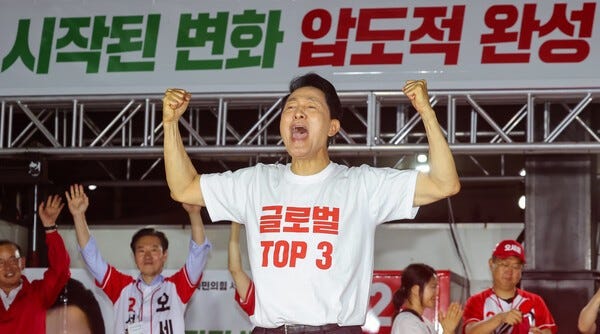
In one of the most improbable elections I watched unfold, Seoul Mayor Oh Se-hoon won his fifth term over consensus favorite, the liberal candidate Jung Won-oh, in a nail-biter on June 3. Oh trailed behind Jung in nearly all polls in lead-up to election day, and exit polls forecasted a Jung victory between three and eleven percentage points. Oh ultimately won by 1.15 percent. With 95 percent of the votes counted, Oh for the first time took the lead, completing a stunning upset that has rocked South Korean politics since. And this victory may shape Seoul’s urban fabric for decades to come.
Of the twenty-odd posts I have published on this blog, no one character has been featured more frequently than Mayor Oh. For longtime readers, this may be not be surprising, considering the increasing focus I have toward covering South Korean urbanism. Oh has cameoed in three posts: on the installation of Platform Screen Doors in Seoul Metro stations; on the ongoing protests inside Seoul Metro stations and trains by disability rights activists; and on the redevelopment feud involving a neglected high-rise building complex in central Seoul. Even when not directly mentioned, Oh’s influence creep around the shadows in other blog posts about Seoul; such is the power of a mayor of a metropolis of 10-plus million people elected five times to the post (no other mayor in Seoul history has been elected more than twice). No one politician may be more responsible for elevating Seoul’s reputation to the global heights it is currently enjoying than Oh Se-hoon.
This blog rarely touches upon current events, as I usually like to span narratives far back in the past. But I felt compelled to do a quick and relatively short recap and analysis on this Seoul mayoral election because I felt it was special in three key ways. First, the issues that defined and animated this race between Oh and Jung were about issues this blog focuses on — transportation and housing. The candidates’ proposals, strengths, and weaknesses to transportation and housing issue serve as a portal to better understand Seoul’s current conditions on both areas and how it may change under another Oh term. Second, this mayoral election gives me an opportunity to explain Seoul’s strong-mayor system and the local political coalitions at play which helped Oh pull off a shocking election win. Third, Oh’s fifth mayoral victory in twenty years should vault him into a pantheon of most consequential big city mayors in the 21st century, joining figures more familiar to readers such as Paris’s Anne Hidalgo or London’s Sadiq Khan. This blog has previously highlighted how mayoral power have shaped urban transportation for generations after, just as Oh already has and will continue to shape Seoul. Oh has been critically under-examined outside of South Korea. This post attempts to sketch and fill in the blanks.
Author’s note
You can help support my work at S(ubstack)-Bahn by putting some money in the Ko-fi tip jar.
“The Little President”
Few countries around the world has as much a co-dependent relationship with its capital city as South Korea does with Seoul. It is the capital city and home to nearly a fifth of the overall population; it is also the political, economic, and cultural heart of the country, housing all relevant institutions inside city borders. Expectedly the Mayor of Seoul holds a special place in the governmental hierarchy. Unlike all other mayors in the country, the Mayor of Seoul is recognized by national law at the same level as a Cabinet minister and thereby is granted a seat at the national State Council meetings. This means that the Mayor of Seoul can directly report to the President at these meetings on city affairs and give feedback on national policies that will influence the capital city. Other South Korean mayors correspond with department ministers when in need of national government resources; the Mayor of Seoul has a special direct line to the Prime Minister, the second-in-command of the government.
This exclusive status to the Mayor of Seoul, first granted in 1962, gives them very broad latitudes in their scope of power. First, the Mayor is in charge of a 40 trillion Won ($25 billion USD) municipal budget with 17,000 civil servants the mayor can hire and fire at will. The Mayor sits at the top of six public corporations, such as the Seoul Metro Corporation, which oversees all Seoul Metro lines 1-8 (and parts of Line 9), and the Seoul Housing & Communities Corporation, the city’s public housing developer. With Seoul Metro, the Mayor commandeers both operational and capital projects; chooses projects for Metro to invest or expedite, such as the Climate Card initiative recently championed by Oh; and approves future line expansion plans. Housing and development arguably is where the Mayor of Seoul wields their greatest power impacting ordinary citizens. Not only does the Mayor sit atop the Seoul Housing & Communities Corporation, they have authority to determine the speed and scale of urban renewal projects for private developers, which comprise nearly 90% of Seoul’s housing supply, to follow. The Mayor can unilaterally amend the urban planning ordinances to designate new areas for housing projects and determine new projects’ height limits and density requirements — as was controversially demonstrated when Oh fought the national government and UNESCO to raise height limits on a new development project which may cast shadows and block the skyline over the sacred Joseon-era Jongmyo Shrine. The Seoul Metropolitan Council avails itself as the legislative arm to pass laws and even veto the Mayor, but in this strong-mayor system, the Mayor often dictates the policies and priorities of the city and the Council follows suit.
The Mayor of Seoul operates a bureaucracy fit for a small nation-state, hence why one longstanding nickname for the position in South Korea is “Little President” (소통령, 小統領). Recognizing the importance of this position, South Korean presidents selected the Mayor of Seoul until 1995, when mayoral elections replaced direct presidential appointments. Under President Park Chung-hee in the 1960s and 1970s, mayors of Seoul played a critical role in mapping and constructing the first four lines of the Seoul Metro, often at their personal digression without any public input. Two former Seoul Mayors rose to power to become president of South Korea: first, Yun Po-sun, who shortly served between 1960 and 1962 before being removed from office by Park in a coup d’etat. Second was Lee Myung-bak, who in the early 2000s embarked on massive urban regeneration projects, including supporting the first Platform Screen Door pilot at Seoul Metro stations. Lee, eyeing the Presidency in 2007, decided not to run for re-election in 2006. Instead, he selected a young, telegenic lawyer as his heir: Oh Se-hoon.
A water filter commercial Oh Se-hoon filmed in 2004, two years before becoming Seoul Mayor
The rise, fall, and rise of “Ohseidon”
When comparing to politicians in Western countries, Oh can be characterized as both fiscally and socially conservative. Perhaps that is an unusual pairing to succeed in a metropolitan electorate, especially one as large and globalized as Seoul, but Oh has repeatedly transcended political labels to build an unique individual brand that served his political rise. A young lawyer who made his splash by suing apartment developers blocking sunlight on nearby residents in the 1990s, Oh was elected into the National Assembly in 2000 as an environmentalist conservative representing the Gangnam haute moderates. For the rest of his career, the wealthy, right-leaning apartment homeowners of Gangnam served as his base of political power. Starring in commercials for suits and water filters in the 1990s and early 2000s, Oh portrayed himself as dashing, clean-cut, and cosmopolitan — a South Korean Kennedy destined for high office. In 2006, at the age of 45, Oh became the youngest mayor in Seoul history.
In his first stint as Mayor, between 2006 and 2011, Oh levied his powers to remake Seoul as a green, clean, and sleek city worthy of international admiration. Oh pushed through his predecessor Lee’s Platform Screen Doors initiative at Seoul Metro, installing ceiling-to-floor barriers in all Seoul Metro stations in his first three years. Oh focused on large-scale redevelopment projects, such as the Han River Renaissance Project which created a chain of new parks, public spaces, and tourist attractions along the Han River waterfront and the futuristic Zaha Hadid-designed Dongdaemun Design Plaza complex. After eking a close re-election victory in 2010, Oh wagered and lost the biggest political gamble of his career in 2011: a direct referendum to discontinue free lunch benefits at Seoul public schools. When the referendum failed to pass, Oh bore responsibility and, to the shock of the Korean political establishment, resigned as Seoul Mayor.
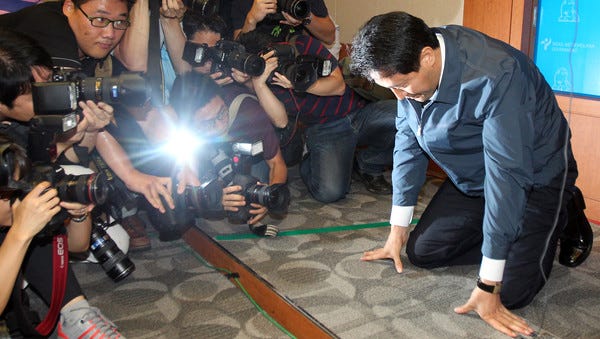
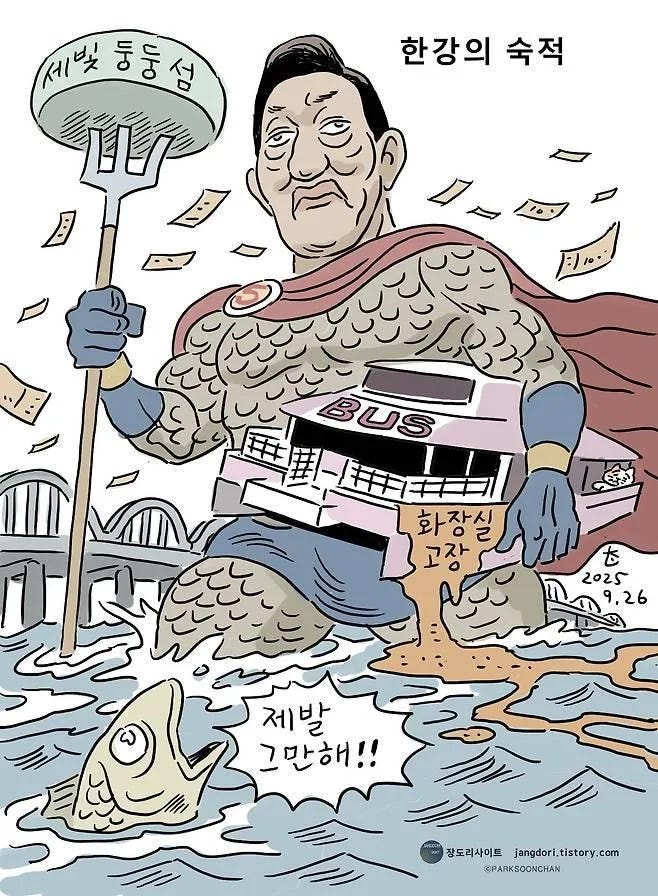
After a decade in the political wilderness following his resignation, Oh was elected for his third term in 2021 in a by-election, and then a fourth and full four-year term the following year. Oh won both elections by around 20 points, relying on heavy support from the conservative Gangnam area and increasing support from the Han riverfront districts, where he helped beautify in his first term. The mayorship became open after Oh’s liberal successor, Park Won-soon, committed suicide in July 2020 after allegations of sexual harassment against his staff emerged publicly. (Park took a different approach to redevelopment policies in Seoul, opting for gentler density and a focus on anti-gentrification effects by new housing projects.) Ushered back into City Hall, Oh reversed much of Park’s policies and carried from his first term his modus operandi: large-scale, sweeping urban renewal projects under the banner of elevating Seoul’s global prestige and real estate values. The Han River Renaissance Project received a reboot under Oh’s second term, and a major focus of the reboot was the Hangang Bus ferry service which began operations in 2025 after several delays, cost overruns, and safety issues. As Oh’s detractors ribbed him for his obsessive focus on remaking the Han River and his poor handling of historic floods from the same river, bestowing the nickname “Ohseidon” after the Greek god of oceans, Oh faced growing opposition over his assertive and even roughshod style of mayorship, especially around urban renewal and redevelopment.
Oh’s political fortunes became more complicated on the night on December 3, 2024, when President Yoon Suk-yeol declared martial law on live television. Protesters gathered outside the National Assembly in Seoul to block soldiers from entering. Even though Oh, a member of Yoon’s People Power Party (PPP), was one of the first conservative politicians to oppose the martial law announcement, Oh by association was expected to lose re-election as part of an expected anti-Yoon electoral wave, as first demonstrated when opposition leader Lee Jae-myung was elected president in a snap election in 2025. Oh was supposed to be on the outs heading into his final re-election bid.
The 13th hour comeback
Since his election in 2025, President Lee Jae-myung has enjoyed a high and sustained approval rating north of 60 percent. In hopes to convert his personal popularity to electoral success for his Democratic Party of Korea (DPK) in the June 2026 regional election, Lee hand-picked his favorite for Seoul Mayor: Jung Won-oh, the administrator of the Seong-dong District on the east side of Seoul. Jung had been the administrator since 2014 and built a reputation as a capable and careful governor. Jung helped transformed the former industrial backwater of Seongsu into a trendy hotspot replete with cafes, luxury fashion stores, and art galleries, earning the moniker “The Brooklyn of Seoul.” On the transportation front, Jung launched an intra-district free shuttle bus service and South Korea’s first “smart” bus shelters and crosswalks — amenities each equipped with technologies to protect bus riders from the weather elements and pedestrians from distracted drivers, respectively. Unlike Lee, who built his political reputation as a capable but often sharp-tongued mayor of Seongnam, a suburb south of Seoul, Jung was seen more as a quiet-speaking technocrat focused on the fine details. In the campaign trail, Jung advertised himself as a humble civil servant who will work in harmony with the Lee government — everything the swashbuckling, self-confident Oh was not.
For both Jung and Oh, real estate was the primary issue from the outset of their campaigns. A post-COVID slowdown in new housing construction and a explosion in demand to move to Seoul for jobs (at the expense of rapidly depopulating cities in the far-flung regions down south) has produced a serious housing crisis, where apartment valuations have increased by double digit percentages year-over-year and renters increasingly unable to afford living in the capital. From the big picture, both candidates offered similar promises; they both pledged more than 300,000 new housing units in Seoul by 2031 and fast-tracking reconstruction work on aging apartment complexes. But the tenor was very different: Jung pledged a closer working relationship with the Lee administration to provide more housing through public-private partnerships and working through proposed national regulations, such as a real estate tax and a mortgage cap, to cool Seoul’s red-hot real estate market. Oh dismissed such careful nuance and spoke urgently of the need to deregulate the housing market to spark a mass construction boom. Whereas Lee and Jung sought to solve Seoul’s housing crisis by cooling the red-hot short-term speculation and right-sizing the housing market (i.e. moving government agencies and its jobs out of Seoul to smaller, depopulating cities down south), Oh promised more housing everywhere for everyone through his trademark large urban renewal projects — all while leaving the speculative mechanisms in place as to insulate the lucrative real estate market from government intervention.
In the final weeks leading up to the election, the mayoral race was shaken up by two events which brought a new topic into focus: construction safety. Per an exclusive news report from MBC on May 18, nearly half of the planned metal rebars placed inside concrete beams to uphold the giant underground platform at Samseong Station was missing, raising structural integrity questions on the mega-project. The platform would link two legs of the GTX-A high-speed commuter line — similar to London’s Elizabeth Line — at the heart of Gangnam, the most trafficked part of Seoul. Jung railed into Oh, claiming this rebar incident was symbolic of the reckless Oh administration, and that Oh was inviting risk of catastrophe to a city marked by engineering disasters, such as the Seongsu Bridge collapse or the Sampoong Department Store collapse. Eight days later, on May 26, an overpass under demolition collapsed, killing three workers. Jung repeated this election was about building a safer Seoul, and Oh has made Seoul unsafe. The polls leading up to election day noted an uptick for Jung, hinting his safety message was making inroads with the electorate.
On election night, Jung took a double-digit leads for the first several hours of ballot counting, likely due to the case that several polling centers at Songpa District — a long-time stronghold for Oh and the PPP — ran out of ballot papers, sparking mass protests outside. But as the count wore on, Oh chipped away at Jung’s lead through two fronts: first, Oh’s traditional power bases around Gangnam and the Han River waterfront districts came out in droves to support the 65-year-old Mayor. Gangnam and its neighboring Seocho District supplied an overwhelming lead for Oh that Jung could not counter with his traditional DPK voter base in the outer districts, where lower income residents are concentrated. Second, both men and women in their 20s and 30s voted overwhelmingly for Oh, surprising pundits on election night. Postmortems found young Seoul residents, especially women, shed their liberal leanings to back Oh, a candidate who they believed can quickly calm high housing prices and fierce competition for rentals. And on the 13th hour of ballot counting, after the sun rose the day after election night, Oh Se-hoon took the lead for the first time to win an election that, just the night before, was expected to handily lose.


A mayor for a generation
Despite my longstanding fascination with Oh as a politician, I find much of Oh personally contemptible. Oh is deeply anti-LGBTQ and openly expressed his opposition to homosexuality; he has previously blocked Pride parades in Seoul, which he described as “lewd” immoral affairs. As mentioned earlier, he once staked his entire political career on banning free lunches for schoolchildren. With regards to disability activists protesting for better conditions in public transport, Oh adopted a “zero tolerance” attitude to these spontaneous protests, which escalated into Seoul Metro staff shutting down elevators to block wheel-chaired participants from entering underground stations. (The protests, which started in 2021, are still ongoing.)
With his latest victory, Oh is no longer allowed to run for re-election, as the Seoul Mayor is termed out after three consecutive terms. And it is unclear how much sway Oh can have in his last term, as the same Seoul voters who re-elected him also voted to deliver a DPK super-majority at the Metropolitan Council, giving Oh’s opponents an avenue to check his sweeping mayoral powers. Oh will also have to contest with President Lee Jae-myung for the entire term; both Oh and Lee will finish their times in office in 2030. And, lastly, due to the ongoing protests and public outrage over the ballot shortage fiasco, there is a sliver of a chance that the Seoul mayoral election will have some partial re-do, despite the protesters for the re-do themselves largely supporting Oh on election night.
Can we map out what Mayor Oh will be able to accomplish in his tenure? On the transportation end (after all, this is a transportation blog), little is expected to change. First, beleaguered Hangang Bus, which Oh has constantly defended, will carry on operations; Oh guaranteed the ferry service will become profitable by 2028. On the campaign trail, Oh pledged seven new subway lines — focused on connecting the northern half and the western districts of Seoul — will begin construction by 2029. Oh is expected to expand the Climate Card fare benefits, such as transfers for GTX lines within Seoul perimeters and a welfare payback program for lower-income users which began earlier this year to combat high fuel prices.
Oh’s impact will be far more reaching in housing. It is unclear whether Oh will fight the national government and even risk stripping the Jongmyo Shrine of UNESCO Heritage certification to build taller multi-use high-rises across the street. What seems more likely are more widespread designations for redevelopment and “New Town” zones to fast-track wide demolitions of decades-old lower-density housing to build high-rise apartments. One such example of this transformation is Hannam-dong, a hillside neighborhood overlooking the Han River. The hill once was covered with brick single-story houses with a cathedral perched atop, like some quaint European town, and served as a popular shooting site for Korean television dramas. Designated as part of the Hannam New Town in 2018, the entire hill has been razed earlier this year to make way for 5,800 housing units, now plainly seen when walking along the Han River.


Seoul’s mayor as heavy-handed urban transformer is nothing new; since the special ministerial-level position was granted in 1962, Seoul mayors have used their powers to remake the cityscape in their image. (The 1960s mayor Kim Hyun-ok, nicknamed the “The Bulldozer”, comes to mind.) But one can argue that the Mayor of Seoul did not become democratic and legitimate until 1995, when the first direct mayoral election began, which then means this relatively young position is ripe for setting shape. When seen through that lens, Oh Se-hoon’s legacy is magnified; in the past 31 years of democratic mayoral rule, 10 were under Oh, with another four to go. By 2030, when Oh’s term ends, no singular Korean will arguably reshape Seoul in the 21st century more than Oh Se-hoon.
Who do I need to talk to to get you an advance for a Power Broker-scale tome on Mayor Oh?
I cherish your pieces when they arrive in my inbox, thank you for helping me keep in touch with the motherland
Another fantastic right-up!
It is a shame to see another more-of-the-same conservative pol win in Korea. Especially given the increasing extent to which Seoul (or more accurately Sudogwon) is Korea and Korea is Seoul, that no one's angling for more radical change is a lost opportunity--not that Korea's left has much to offer, sadly enough.
It also seems like the country's nearly given up on meaningful decentralization around Seoul. Yes, they keep moving ministries out of the capital, but national investment priorities including (dubiously-useful) semiconductor manufacturing seem to move no further away than Chungnam, and the kinds of reforms SK really needs around things that could provide long-lived economic activity outside the capital region--like easing transmission infrastructure construction for renewables in the countryside--continue to be drawn out.
I know there's a kind of inertia around these things that's difficult to escape, but the difference in sense of vitality between Seoul and even Busan is really remarkable, even as the latter maintains its niche in shipping and maritime industries, with a decent foothold in finance. Nonetheless, the extent to which Korea just seems content to speed-run Japan's economic dead-ended-ness, especially if AI turns out to be just the bubble it sure seems like it is.
Voters focusing on "kitchen table" issues like housing costs is perfectly reasonable, but if the people in charge of the country--very much including the mayor of Seoul--can't broaden their horizons, there's no bright future ahead.