
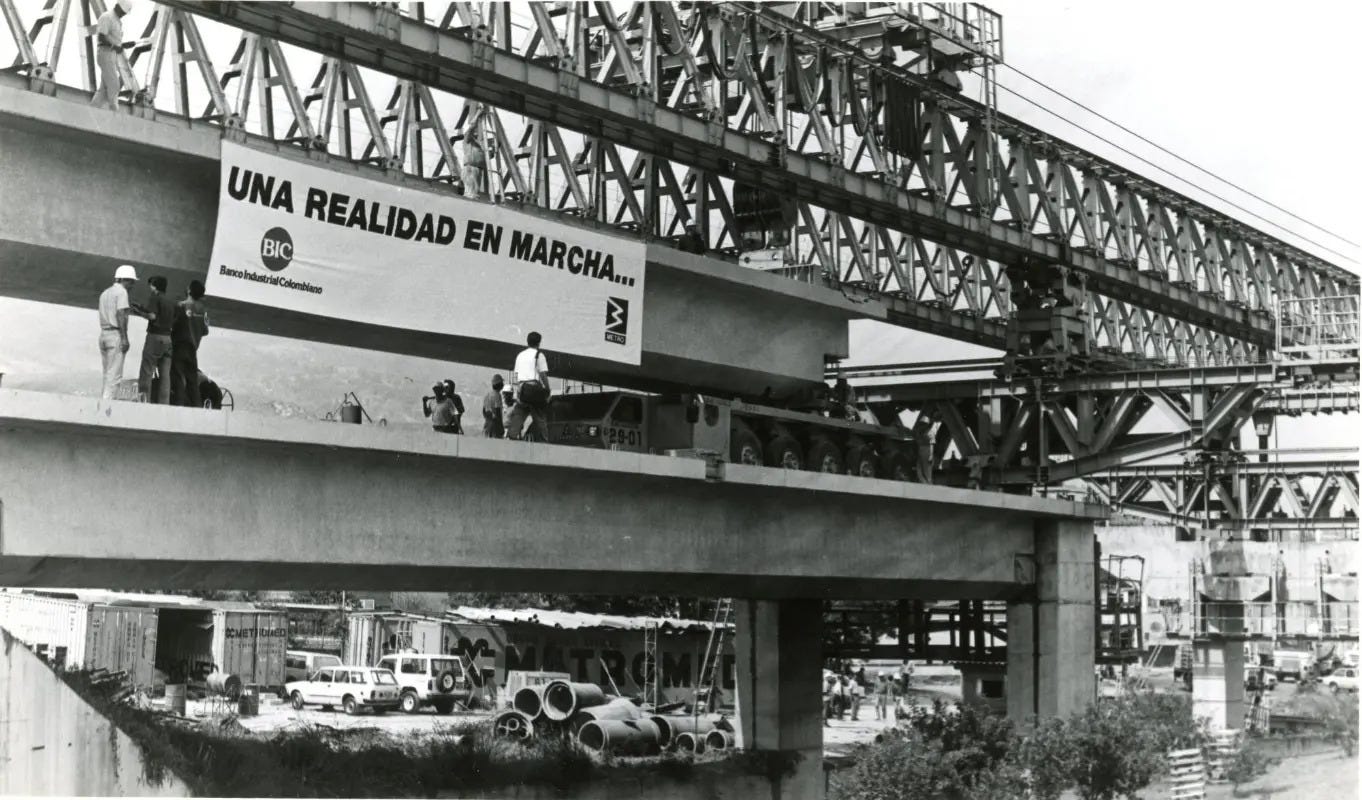
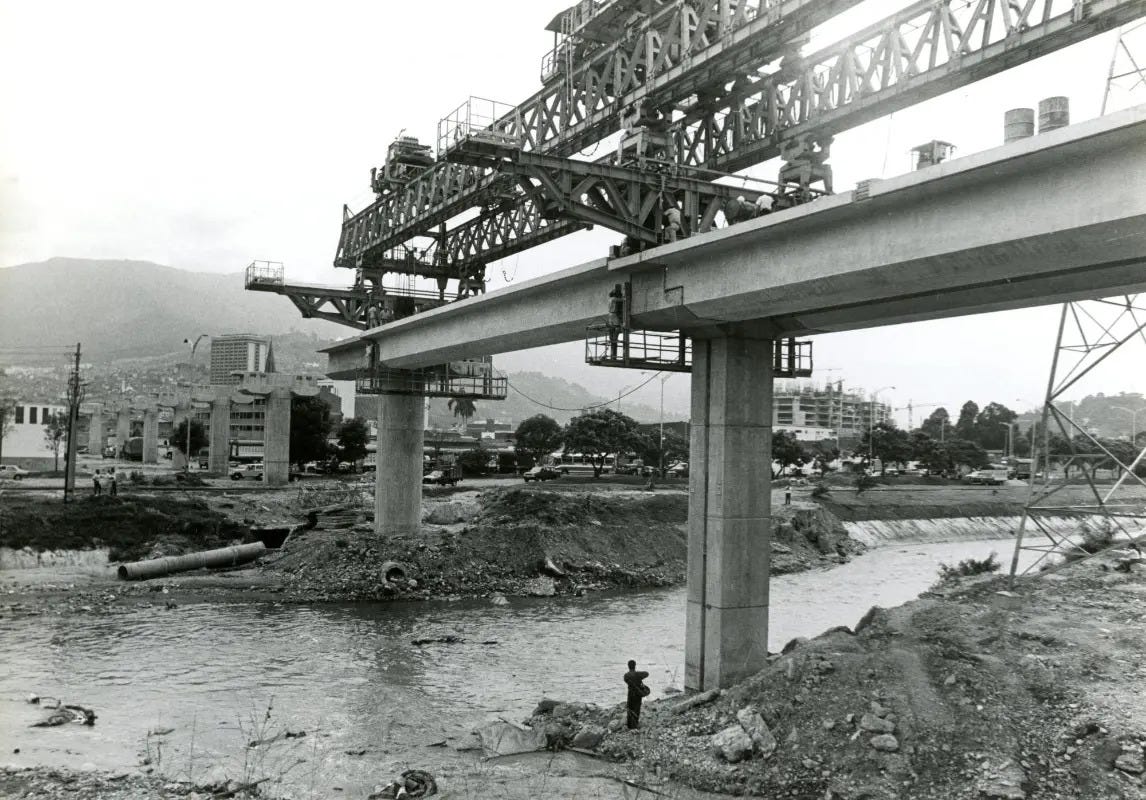
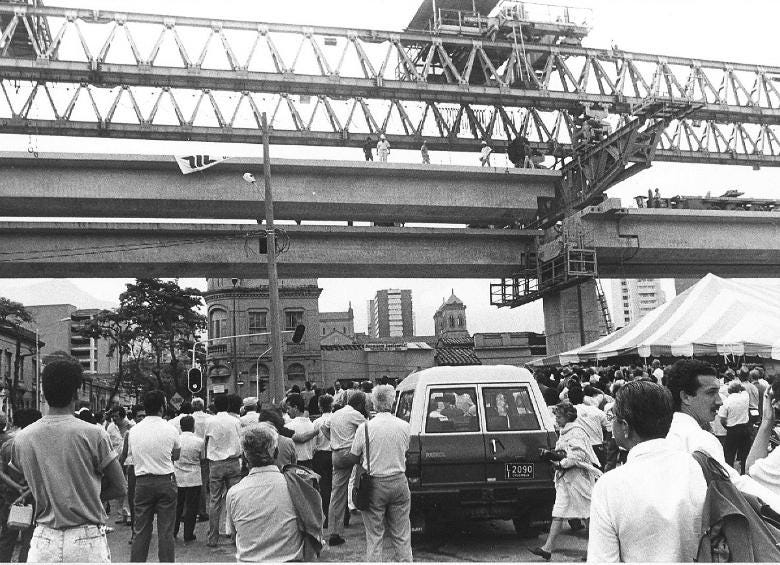
As daily hails of gunfire shook the streets of Medellín in 1991, residents found an apt symbol for civic dysfunction in the giant abandoned ruins of its planned metro system. Open trenches and tall mounds of dirt along the banks of the Medellín River sat untouched, like a festering wound. A six-kilometer-long slab of concrete lay unprotected near the city center; at night, vagrants called it home, hiding from the violence. The structures had been abandoned for two years, and there were no signals they would ever be finished.
That year, 6,349 people were killed in Medellín; an average of nearly 17 people per day were murdered in heated gunfights or in cold blood.1 The urban center of the Antioquia region had descended into a battlefield between drug cartels, including the infamous Medellín Cartel, led by Pablo Escobar; Colombian military and police units; and leftist guerilla groups who had fought the state since the 1950s. Outside Colombia, Medellín earned the notorious moniker “the murder capital of the world”. It registered the highest homicide rate in the city’s history in 1991. And somehow, just six years prior, Medellín had taken the plunge to build Colombia’s first ever mass transit rail system, a confident gamble on its own future.
This attempt came to a screeching halt on October 26, 1989, when it was abandoned overnight. It took years of concerted effort by the Colombian state to revive the construction of the metro in 1992. Three years later, in 1995, the Medellín Metro (Metro de Medellín) finally opened for service amid huge, emotional fanfare. Now, in its thirty-first year of operations, Medellín Metro is hailed in and out of Colombia as a dual symbol: first, as a success story within the Latin American public transit landscape, and second, as a civic symbol of Medellín’s post-Escobar rejuvenation. The Metro’s cablecars, which glide over hillside neighborhoods, providing incredible vistas of the bowl-shaped city, are often touted as an icon of Medellín’s efforts to reduce the city’s poverty, inequality, and violence by bridging poorer barrios to the affluent city center. The Medellín Metro – consisting of two heavy rail lines, two tram lines, six cable car lines, and three bus rapid transit lines – now moves more than 800,000 riders daily, comparable to Washington D.C. metro in ridership.
I had the pleasure of visiting Medellín in 2019 and came to fully appreciate its wonderful metro. Its convenience, cleanliness, and orderliness were on par with the great systems of East Asia and Europe, and the locals beamed with unmatched pride when sharing the history of the system. I learned while researching this article that this pride was partly manufactured: the Cultura Metro program – the ubiquitous social face of the Medellín Metro – was started during the metro’s construction to prepare residents for the incoming transit network and foster civic pride at a time when the city was at its bloodiest and most chaotic. And when the Metro did open in 1995, Cultura Metro pivoted into a comprehensive social outreach program, providing libraries, festivals, pop-up health clinics, classes, and more directly on metro property and on its rolling stock.
English-language articles highlighting Medellín Metro’s successes are plentiful in academic and journalistic outlets, but none have ventured to detail the dramatic origins of the system. This author finds this lack ironic, considering the ever-growing global fascination with Pablo Escobar and the emergence of narco-tourism in Medellín. This blog has frequently covered the origin stories of mass transit systems and the political and economic conditions from which they were born; this dive into the Medellín Metro is no different, though perhaps there was more at stake with this system than its peers, say, in Japan and South Korea. No city in history, as far as I can recall, has attempted to build a metro system from scratch as the city and country were both under heavy siege by violent forces from within. And less can I recall of a city which succeeded in those odds. The metro’s death and resurrection is closely connected to Colombia’s broader political transformation catalyzed by the hyper-violence and trauma the country endured in the 1980s and 1990s. Like a pair of tracks, the Medellín Metro and Colombia would run parallel in its journeys of rejuvenation.
Author’s note
I would like to thank Katharine Khamhaengwong for editing this story. Please follow her at @katharinegk.bsky.social.
You can help support my work at S(ubstack)-Bahn by putting some money in the Ko-fi tip jar.
Medellín: Colombia’s rail mecca
Located in the center of the large Aburrá Valley, the river basin of the Medellín River, the city grew in stature from the small village it had been under Spanish and early Colombian rule alongside an important local commodity: coffee. As the capital city of the Department of Antioquia, Medellín soon became the logistical center for the burgeoning Colombian coffee export market, and trains became the vehicle to move the beans out of the valley and into the world. In 1875, Antioquia Railways was founded, headquartered in Medellín. Coffee, coal, and textiles were shuttled out of the steep mountains which surrounded the Aburrá Valley by Antioquia Railway trains. Both the company and the city experienced an economic boom, and Medellín soon became the most developed city in Colombia. Company and city continued to grow even as the rest of Colombia devolved into chaos during the internecine Thousand Days War between 1899 and 1902.
In 1929, Antioquia Railways reached its engineering zenith: a 3.5 kilometer tunnel east of Medellín to cut through the mountains to connect to Puerto Berrío, a port town on the Magdalena River, which flowed out into the Caribbean.2 The tunnel was largely funded with money from the United States — under the 1921 Thomson-Urritia Treaty, the United States cut a check to Colombia of $25 million (~$450 million today) in exchange for Colombia’s recognition of the newly independent country of Panama, splintered from Colombia only eighteen years prior, to its north. The Cisneros tunnel was to strengthen Antioquia Railways’ rail monopoly in Colombia’s export-based economy, but soon after the tunnel’s completion, the world economy collapsed into the Great Depression. Colombia’s economy took a crushing blow. In 1934, Antioquia Railways registered its first deficit; its financial standing worsened with every passing year.3 By the 1950s, the railways were in terminal decline and received little support from the government, which was occupied by a brutal civil conflict known as “La Violencia”. In 1961, Antioquia Railways was liquidated and its assets were taken over by the Colombian government.
Antioquia Railways’ demise left miles of tracks and right-of-way spanning Medellín unused. Cutting through the center of the city, they couldn’t be ignored, and sparked frequent proposals for how to convert them back to use. In 1963, Medellín’s Municipal Planning Office proposed an urban mass transit system to run through the bowl-shaped city, which was then experiencing a massive population boom. In 1968, the same office decided to have that mass transit line run north-south by the Medellín River. In 1979, the city of Medellín created the Aburrá Valley Mass Transit Company – the predecessor to the Metro – to lead construction and operations of such a transit system, at an estimated cost of $650 million. This cost in Colombia’s history would be split, with the national government in Bogotá covering 40 percent and the city and the Department of Antioquia the remaining 60 percent.4
It would take four years for the transit company to find a partner to help build this new metro system. On November 24, 1983, it entered a contract with the Spanish-German Consortium (Consorcio Hispano Alemán Metromed, CHA), which included the Spanish energy conglomerate Acciona and German engineering giant Siemens, among others. The project officially began on April 30, 1985, nearly 18 months after the signing.5 Two heavy rail lines in the shape of a cross would begin the metro network.
At the CHA contract signing, Colombian President Belisario Betancur spoke of the monumental challenge of building Colombia’s first urban rail network as the country frayed by rising violence between the state, the leftist guerilla paramilitary group Fuerzas Armadas Revolucionarias de Colombia (FARC), and the emergent drug cartels:
Our history has never been a fairy tale, but a story forged by force, of men facing a hostile environment. A man who, always in the midst of great crises, undertook audacious projects: didn’t we build the railroad in the midst of civil wars?6
Betancur’s lofty words would prove both prophetic and understated in the years to come.
A corpse in the living room
When the CHA signed the contract to construct a metro system in Medellín in 1983, the goal was for the first operational train to be in service within five years. Instead, the project took 12 years in total, the budget ended up nearly four times higher than initially agreed upon, and the working relationship so deteriorated it sparked a courthouse odyssey which was finally settled in Panama in 2009.
In 1985, the CHA filed its first claim against the Medellín Metro, saying its start to the construction was unjustifiably delayed by the Metro and city which resulted in cost overruns of around $60 million. The metro refused to pay the CHA the alleged overruns. Despite the CHA’s grumbling, construction ultimately began in April 1985.7 As Colombia’s financial standing devolved in the 1980s, CHA experienced persistent issues around funding and difficulties importing equipment. In 1987, the CHA published a lengthy list of demands, which included a cost adjustment of $640 million — nearly the size of the entire budget allocated for the project just four years prior.8
The CHA’s frustrations with the Medellín Metro finally reached breaking point in 1989. On November 30, the CHA suspended all construction and walked away from the job. In response, the metro declared its contract with CHA null and void. Stunned, city officials had to contend with a half-finished viaduct sitting out in broad daylight. One Antioquia official called it a “corpse in the living room.”9 The concrete carcass soon became a hive for the homeless and criminals; Omar Florez Velez, Medellín’s mayor between 1990 and 1992, said numerous citizen groups proposed these viaducts be converted to a highway for cars or even a bicycle path, anything to repurpose it and end its sad, abandoned state.10
Medellín’s struggles to build a metro coincided with degradations in public safety, economic strength, and political stability across Colombia in the 1980s. Murders in Medellín climbed in the first half of the 1980s then shot up dramatically after 1985. Medellín – a city then of around 1.5 million – recorded 1,698 murders in 1985; the number more than doubled to over 3,500 in 1986.11 It would grow steadily until its peak of 6,349 in 1991. (As one comparison, New York City, at several times the population of Medellín, in 1990 recorded its highest-ever murder count in one year at 2,245.)
After stable economic growth in the 1960s and 1970s, a sharp collapse of coffee prices in the late 1970s and an aggressive hiking of interest rates in the United States – known as the Volcker shock – snowballed in Colombia into a full-blown financial crisis by 1980. In 1982, the Colombian government stepped in to take control of the country’s largest bank to prevent it going under.12 High rates of inflation, fluctuating between 15 and 30 percent annually between 1980 and 1989, heavily devalued the peso not only against the US dollar but also against the currencies of use for the Medellín Metro’s builder, the CHA: the German mark and the Spanish peseta.13 By 1989, in addition to technical difficulties, the CHA faced budget issues from the fact that the peso held a fraction of its purchasing power compared to 1983.
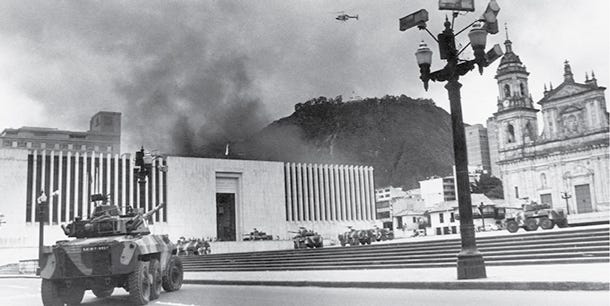
Politically, the 1980s were ten consecutive years of horror, but two years in particular pushed the system into near-collapse: 1985 and 1989. On November 6, 1985, the far-left guerilla group M-19 stormed the Palace of Justice, Colombia’s highest court, in Bogotá and took more than 300 people hostage, including Supreme Court justices, judges, and magistrates. The guerillas took over the building with the stated goal of placing President Bentancur to trial for various crimes. A chaotic two-day rescue operation led to 98 deaths; 11 of 25 Supreme Court justices were killed in the melee.14 A week later, on November 13, the Nevado del Ruiz volcano, about 131 km west of Bogotá, erupted and subsequent mudslides killed more than 23,000 people in nearby towns. Under heavy criticism for slow government response to the eruption’s rescue efforts, President Betancur said “time and time again we are visited by tragedy.”15
Events in 1989 left Colombia’s political legitimacy on the brink. First, on August 29, liberal politician Luis Carlos Galán — considered the frontrunner in the upcoming presidential election in 1990 — was killed in public by hitmen hired by cartel kingpin Escobar.16 Three months later, on November 27 — three days before the CHA’s suspension of the metro project — the Medellín Cartel snuck a bomb onto an airplane heading from Bogotá to Cali and detonated it mid-air; all 107 persons on the flight were killed. But Escobar missed his main target: Galán’s successor, César Gaviria, who had decided at the last minute not to board the flight.17 Nine days later, on December 6, a truck loaded with a half ton of dynamite exploded in central Bogotá, targeting the nearby federal Administrative Department of Security building. Fifty-seven people died and more than 2,200 people were injured by the explosion. While never confirmed, the Medellín Cartel is believed to be responsible for that bombing as well.18
However, amid the chaos, positive political change was rapidly afoot, on two fronts. First, numerous leftist guerilla groups began an unstable transition away from their violent, armed past toward becoming peaceful political parties. In 1985, the FARC agreed to a ceasefire and formed the leftist party Patriotic Union (Union Patriótica, UP). The M-19 group, responsible for the Palace of Justice siege, gave up their weapons and formed the M-19 Democratic Alliance party. Both parties’ candidates for the upcoming May 1990 presidential election were assassinated during their campaigns.19
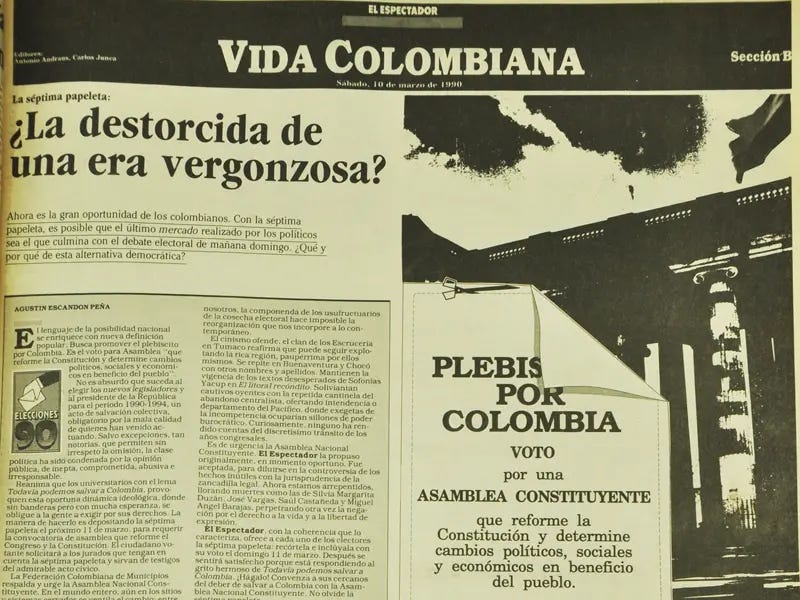
Second, university students in Bogotá in 1989 began a non-violent campaign to demand the replacement of the current constitution, which they saw as the source of the state’s instability. In the lead-up to the March 1990 legislative election, they proposed voters submit an additional blank ballot with the six official ballots as an unofficial vote in favor of a new constitution. Backing the movement for the unofficial seventh ballot (“la séptima papeleta”) national newspapers printed cut-out ballots on election day.20 The seventh ballot was never officially tallied, but newspapers reported more than two million submittals. In immediate response to this movement, President Virgilio Barco Vargas decreed a referendum on whether a Constitutional Assembly should be formed to write a new constitution would be placed alongside the upcoming presidential ballot in May 1990. More than 95 percent of voters voted for the Constitutional Assembly, which began its work in February 1991. After four months of intensive deliberation, the new Colombian Constitution was promulgated on July 4, 1991.
The new constitution had immediate effects on Medellín and its most infamous son, Pablo Escobar. It included a ban on extraditing Colombian citizens abroad, which meant Escobar would no longer be relocated to the United States if arrested. Under pressure to surrender following newly elected President Gaviria’s escalation against the Medellín Cartel, Escobar agreed in 1991 to surrender, on the condition that he be imprisoned in his personal mountain compound overlooking Medellín.21 Apparently unwilling to actually face prosecution, he escaped the next year, choosing to spend the last seventeen months of his life on the lam. On December 3, 1993, the 44-year-old Escobar was discovered, shot, and killed by the Colombian Special Forces, finally ending the life and saga of someone who had once been one of the richest men in the world. With Escobar’s death, the country could move forward — and with gusto — to reimagine its civic society.
Because we have faith
By the end of 1991, it had been 25 months since a shovel last touched the ground of the metro project. Train cars procured from Europe in 1990 sat hidden and dormant in Medellín, their fate unsure. But, with a new constitutional order providing some semblance of stability in Medellín and Colombia as a whole, its elites were ready to resurrect the metro dream.22
The major cheerleader for the metro’s revival was neither the Colombian government nor the city of Medellín but a local bank: the Colombian Industrial Bank. As longtime financial stewards for the city, the bank believed ardently in the promise of the metro as an investment to the city and began funding campaigns to rally public support to resume construction. They began advertising slogans such as “Quiere el Metro, nuestra gran obra” (We want the Metro, our grand project), “Quiere el Metro desde ya” (We want the Metro now), and “Conozcamos nuestro Metro” (Let’s get to know our Metro). This campaign provided the foundation for the future Cultura Metro program, which would expand into educational and etiquette campaigns in the coming years.23
Behind the motivational slogans, exhaustive negotiations dragged on between the metro and CHA. The differences between the two parties were so great that they required intervention from the heads of three states – Colombia, Germany, and Spain. Colombian President César Gaviria negotiated with Spanish Prime Minister Felipe González to break the deadlock.24 A new law in Bogotá was passed to guarantee additional state financing for the project.
On February 13, 1992, an agreement was signed between the CHA and the Department of Antioquia to restart the Medellín Metro construction. The agreement stated the Colombians would pay CHA $830 million USD in November as a deposit.25 It also agreed to extend the deadline for completion by 38 months, until April 1995, and that future disagreements would be settled amicably, with a third party mediator as necessary.26 Few at the time could have foreseen the legal fights that lay ahead.
As construction continued in 1994, the unused train cars were mobilized as models, parked at a city center plaza to begin Cultura Metro’s etiquette campaign. Residents were invited to learn the basics of passenger conduct, such as not crossing the yellow platform line, paying for tickets, and awareness of closing train doors.27 Motivational messages were repeated over the loudspeakers at these events, stating “Para el metro solo nos faltan centímetros de pasión, centímetros de esfuerzo, centímetros de tenacidad” (All we need for the subway is centimeters of passion, centimeters of effort, centimeters of tenacity).28 By 1995, as the metro neared completion, students, families, and workers were invited to test-ride the trains to familiarize themselves with this new transportation mode.
A video of a Medellín resident who video-recorded taking his family on a test ride of the Metro on November 11, 1995, nineteen days before opening.
On November 30, 1995 — six years to the day from the suspension of the metro’s construction — fifteen stations on the north-south Line A opened for service. Colombia’s new president, Ernesto Samper, pressed the button that began operations. As passengers waited to board their first train, the following message was played over the station loudspeakers: “Lo logramos. Por pujantes, por capaces, por luchadores, por creer, por tener fe” (We did it. Because we are driven, capable, and resilient, because we believe, because we have faith).29 The message was clear enough for one boy, interviewed on camera, to shed tears of joy at how proud he was to ride the metro.
An international court affair
Three months after its November 30 opening, Medellín Metro also opened the west-east Line B, completing the cross-shaped first envisioned some thirteen years ago. A project that started with a $650 million price tag in 1983 finished at a ballooned cost of $2.7 billion.30 And its most complicated ordeal had just begun.
In 1997, the Medellín Metro unilaterally declared a breach of contract with the CHA, stating that the CHA was set to complete its near-expiring contract in an unsatisfactory state.31 This second collapse in the relationship between the metro and the CHA triggered a legal odyssey through several arbitration tribunals in both Colombia and Panama. Neither side dared to back down an inch. Medellín Metro alone had 70 people employed to sift through documents for the legal fight.32 The legal battle reached its climax in November 2007, when two separate court decisions — one from the International Court of Arbitration in Panama and the other from the Administrative Tribunal of Antioquia in Colombia — within a month of each other awarded the CHA and Medellín Metro, respectively, approximately $160 million in damages each, virtually canceling each verdict out.33 As in the early 1990s, the matter required the intervention of heads of state: Colombian President Álvaro Uribe reportedly negotiated with two Spanish prime ministers, King of Spain Juan Carlos I, and German Chancellor Angela Merkel to smooth over the issues.34
In 2009, twelve years after the breach of contract declaration, Medellín Metro and the CHA signed an agreement to end all legal proceedings and disputes. Medellín Metro ultimately agreed to pay CHA a paltry $3,514,409.35
Of Cablecars and Cultura Metro
In 2004, Medellín Metro opened for service Line K, the first of six Metrocable lines. The line starts at Acevedo Station, connecting to train Line A, and rises up the hills to the Santo Domingo neighborhood, overlooking the city below. Santo Domingo, one of so many barrio neighborhoods perched on the Aburra hills, was subject to much of Medellín’s ultra-violence of the 1980s and part of Escobar’s base of power during his kingpin reign. The construction of Line K began a new era of Medellín Metro not only as a transportation provider but as an engine of socioeconomic equity. The driver of that engine has become the Cultura Metro program, which has activated station spaces to host libraries, concerts, museum expositions, vaccination clinics, yoga classes, and youth cultural programs.
By expanding its visibility and bringing amenities directly to underserved privileges, Cultura Metro aims to reinforce its namesake, where cleanliness, etiquette, orderliness are upheld by riders themselves. On my visit to Medellín in 2019, before learning about Cultura Metro, I was struck by the pristine stations and trains and the quietude of the packed train cars during rush hour; it was a deep contrast to the vibrant noise readily available just steps outside the station. Now, I understand this was the result of nearly thirty years of consistent and meaningful social campaigning.
The Medellín now, of cablecars and Cultura Metro programs, is a distant cry from the Medellín of more than 30 years ago, when drugs and terror propelled the city into global infamy. Few who learned of Medellín through TV shows dramatizing that terrible period could have guessed it was concurrent with the same city that aimed to build a full-fledged Metro. To have the bravado to attempt to build a full metro in the 1980s was admirable; to actually complete it and make it a success may be a miracle.
https://www.theguardian.com/cities/2014/apr/17/Medellín-murder-capital-to-model-city-miracle-un-world-urban-forum
https://www.railsouthamerica.com/blog-posts/antioquia-railway-colombia
Ibid.
https://www.elcolombiano.com/Medellín/historia-del-metro-de-Medellín-nacio-en-el-caos-y-resucito-a-la-ciudad-hace-30-anos-FH31366157
https://www.eltiempo.com/colombia/Medellín/metro-de-Medellín-el-dia-que-decidieron-no-seguir-con-las-obras-553232
https://www.elcolombiano.com/Medellín/historia-del-metro-de-Medellín-nacio-en-el-caos-y-resucito-a-la-ciudad-hace-30-anos-FH31366157
https://www.eltiempo.com/colombia/Medellín/metro-de-Medellín-el-dia-que-decidieron-no-seguir-con-las-obras-553232
Ibid.
https://www.elcolombiano.com/Medellín/historia-del-metro-de-Medellín-nacio-en-el-caos-y-resucito-a-la-ciudad-hace-30-anos-FH31366157
https://www.eltiempo.com/colombia/Medellín/metro-de-Medellín-el-dia-que-decidieron-no-seguir-con-las-obras-553232
https://www.dea.gov/sites/default/files/2021-04/1980-1985_p_49-58.pdf
https://mpra.ub.uni-muenchen.de/115662/1/MPRA_paper_115662.pdf
https://www.elcolombiano.com/Medellín/historia-del-metro-de-Medellín-nacio-en-el-caos-y-resucito-a-la-ciudad-hace-30-anos-FH31366157
https://cja.org/what-we-do/litigation/palace-of-justice/
https://time.com/archive/6672492/colombias-mortal-agony/
https://www.bbc.com/news/world-latin-america-38101907
https://english.elpais.com/elpais/2013/10/17/inenglish/1382032171_533607.html
https://www.latimes.com/archives/la-xpm-1989-12-07-mn-253-story.html
https://www.nytimes.com/1990/04/27/world/colombia-presidential-candidate-slain-by-gunman-aboard-airliner.html
https://www.bbc.com/mundo/noticias-america-latina-51829209
https://www.nytimes.com/1991/06/20/world/drug-baron-gives-up-in-colombia-as-end-to-extradition-is-approved.html
https://www.elcolombiano.com/Medellín/historia-del-metro-de-Medellín-nacio-en-el-caos-y-resucito-a-la-ciudad-hace-30-anos-FH31366157
https://www.elcolombiano.com/antioquia/historia-de-la-construccion-del-metro-de-Medellín-FC14165145
https://www.eltiempo.com/colombia/Medellín/metro-de-Medellín-el-dia-que-decidieron-no-seguir-con-las-obras-553232
https://www.elcolombiano.com/Medellín/historia-del-metro-de-Medellín-nacio-en-el-caos-y-resucito-a-la-ciudad-hace-30-anos-FH31366157
https://www.eltiempo.com/colombia/Medellín/metro-de-Medellín-el-dia-que-decidieron-no-seguir-con-las-obras-553232
https://www.elcolombiano.com/antioquia/historia-de-la-construccion-del-metro-de-Medellín-FC14165145
https://www.elcolombiano.com/antioquia/cultura-metro-de-Medellín-cumple-30-anos-CC9260325
Ibid.
https://www.eltiempo.com/colombia/Medellín/metro-de-Medellín-el-dia-que-decidieron-no-seguir-con-las-obras-553232
https://www.portafolio.co/economia/finanzas/metro-Medellín-consorcio-hispano-aleman-ponen-12-anos-disputas-223510
https://www.eltiempo.com/colombia/Medellín/metro-de-Medellín-el-dia-que-decidieron-no-seguir-con-las-obras-553232
https://www.eltiempo.com/archivo/documento/mam-2753238
https://www.portafolio.co/economia/finanzas/metro-Medellín-consorcio-hispano-aleman-ponen-12-anos-disputas-223510
Ibid.
Amazing read!, I'm a Medellín native and this story always makes me feel a little bit emotional, we had all of our odds stacked against us, but despite that we ended up having such a great transit system, that not only is for transportation, but a way to unite the valley and open thousands of doors for all of us.
It's really, really heartening to see public transit successfully utilized for its highest possible purposes. Spaces of peace and purpose; means of opportunity, equally available to all. So many transit systems in North America feel to be provided begrudgingly, either as gestures towards inequality that are so insufficient to their purpose that they simply do not work as intended, or for halfhearted environmentalist signals that do little to further that goal, either. Transit CAN be useful--crucial--for so many social aims. That it's so popularly written-off in so much of--in particular--the United States (including my nominally-progressive Portland, OR) makes reading Medellin's story so refreshing.
Thanks!