
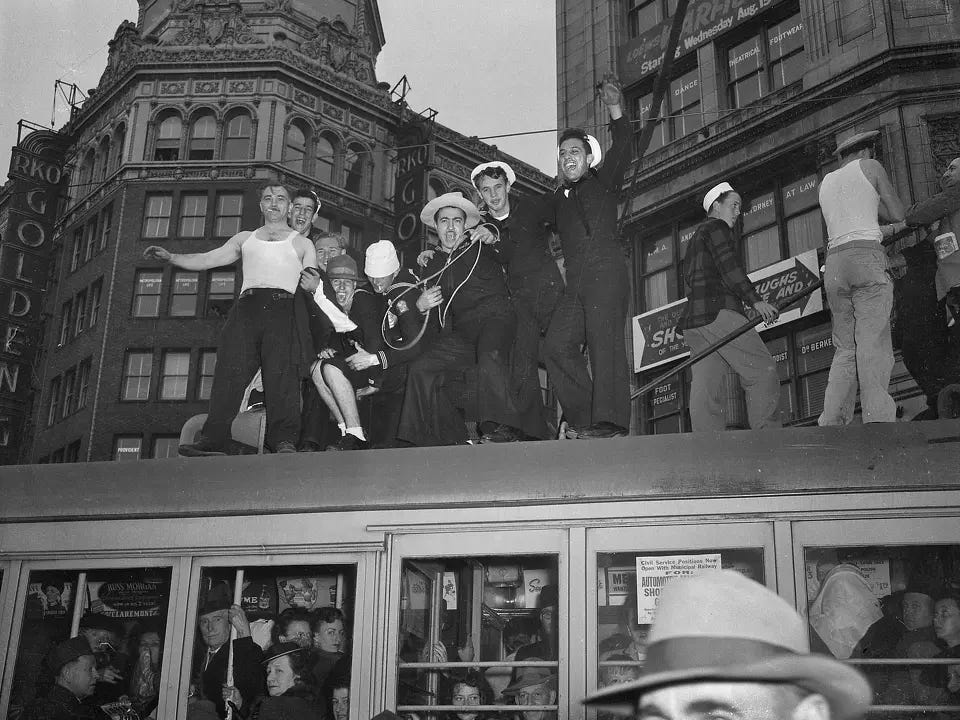
Between April and June 1945, representatives from 50 nations gathered in San Francisco to set the new world order. Thousands of delegates, including heads of state, convened to create the United Nations Charter, setting the foundations for the postwar equilibrium that would soon follow the end of the Second World War.
The venue selection literally came together in a vision: Franklin Delano Roosevelt’s personal secretary, Edward Stettinius, was reminded during the Yalta Conference of San Francisco’s natural beauty facing the Pacific Ocean — an ongoing war front — and thought its geography make for a worthy successor to Yalta in shaping the postwar world.1 Roosevelt liked the idea and pitched San Francisco as the next Yalta to Winston Churchill and Joseph Stalin’s blessings.
San Francisco in 1945 was drunk with the responsibility and possibility of what was to come. Local residents and businesses embraced the United Nations convention, celebrating for weeks, housing foreign dignitaries in their homes, and even providing free laundry for the visitors. As the New York Times quoted in a dispatch, “more than any other city, [San Francisco] is a sign of the promise of resurrection.”2
It’s not too far-fetched, perhaps, to imagine local bureaucrats and elites caught up in this zeitgeist began asking themselves what else could be resurrected on a local level. What things in San Francisco and the surrounding regions could be transformed, and how? Arguably, no one area of daily civic life in the Bay Area had more room for improvement than the mass transport networks covering San Francisco and its neighbor across the Bay, Oakland.
By the time Imperial Japan surrendered in August 1945 to close the war, both the streetcar networks in San Francisco and Oakland were in dire straits. Maintenance deference through the Great Depression in the 1930s, followed by total war mobilization after the Pearl Harbor attack in 1941, meant these streetcar networks had run without comprehensive repair for more than a decade. The problem was compounded by artificially suppressed fares; the streetcar operators had no money to launch to modernize their infrastructure. The private operators wanted to sell and get out of the business as soon as possible. Just as the private automobile was roaring to make a comeback after years of wartime rationing, mass rail transit on both sides of the Bay Area was on its last ropes.
Fast forward to 2026: the Bay Area of the present day sports a large mass transportation network — a victory in itself in the contemporary United States. The region sports diverse public transportation options, from ferries to cablecars. In San Francisco, Muni runs light rail through the underground Market Street Subway and an extensive bus network, one of the most heavily used in North America. In Oakland, the former Key System of streetcars has been completely replaced with AC Transit buses. In the middle, connecting it all, is Bay Area Rapid Transit (BART), a metro-style commuter rail which runs between the two cities via an underwater tube through the San Francisco Bay. Nearly all of this was built within a single post-war generation, between 1945 and 1972.
From this author’s observations as a Bay Area resident and former transit worker, Bay Area transportation history is conventionally told in two chapters: the streetcar heyday, until the 1940s, and then the BART era, starting in the 1960s. This post aims to fill in the oft-forgotten interregnum, the messy bridge which connects the fall of the streetcar to the rise of the Space Age BART commuter train.
This post will focus on the period between 1945 and 1957, when the BART District was created. Heavily relying on a magisterial paper, “Redundancy in Public Transit - Vol III: The Political Economy of Transit in the San Francisco Bay Area, 1945-63,” authored in 1980 by Seymour Adler, a professor of urban studies, I hope to introduce the central cast of characters, coalitions, and conditions that shaped the public transit forms we ride in San Francisco and Oakland today.
This post is delivered with some urgency. This November, the voters of five Bay Area counties are will decide on a ballot measure to help fund BART, Muni, AC Transit, and more than two dozen transit agencies in the region. I think it’s plainly obvious why this measure should be approved, but one complaint I’ve heard repeatedly is that the ballot measure does not address the systems’ structural shortcomings. This is a valid concern. This post aims to explain how these shortcomings came to be during these critical postwar years. As I hope to make clear, these shortcomings often were the result of compromises made by people who once lived, worked, and politicked in the Bay Area. These decision makers are long dead, but they speak from the grave every time we board a local train or bus.
Author’s notes
M biggest thanks to Katharine Khamhaengwong for editing this behemoth. Please follow her at @katharinegk.bsky.social.
You can help support my work at S(ubstack)-Bahn by putting some money in the Ko-fi tip jar. And also vote YES for Measure RTM if you live in the five Bay Area counties!
San Francisco and Muni, 1944-1948
In 1944, San Francisco’s two main transit operators — the publicly owned San Francisco Municipal Railway (Muni) and the private Market Street Railway Company — ran a total of 34 streetcar lines through the city. By that year, the sprawling networks were near breaking point: both operators’ riderships were half of their 1920s peaks, as cars rose in popularity and streetcar reliability fell. Both maintained a five-cent fare throughout the 1930s and 1940s fixed by state authorities, despite both in financial distress.3 That May, the San Francisco electorate voted to approve the consolidation of the Market Street Railway into Muni, after previously rejecting the proposal six different times, reflecting a changing electoral appetites during the war.
Plans for postwar San Francisco transit began before the war’s end. The first plan was devised by Leonard Newton, former general manager of the Market Street Railway turned transport consultant, in April 1945. Newton recommended closing nearly half of the Market Street Railway’s existing streetcar lines and halving the streetcar fleet, from 678 cars to 289.4 The impacted streetcar services would be replaced by more than 300 new buses and trolley coaches. The price tag Newton gave was $23 million (about $426 million in 2026 dollars).5
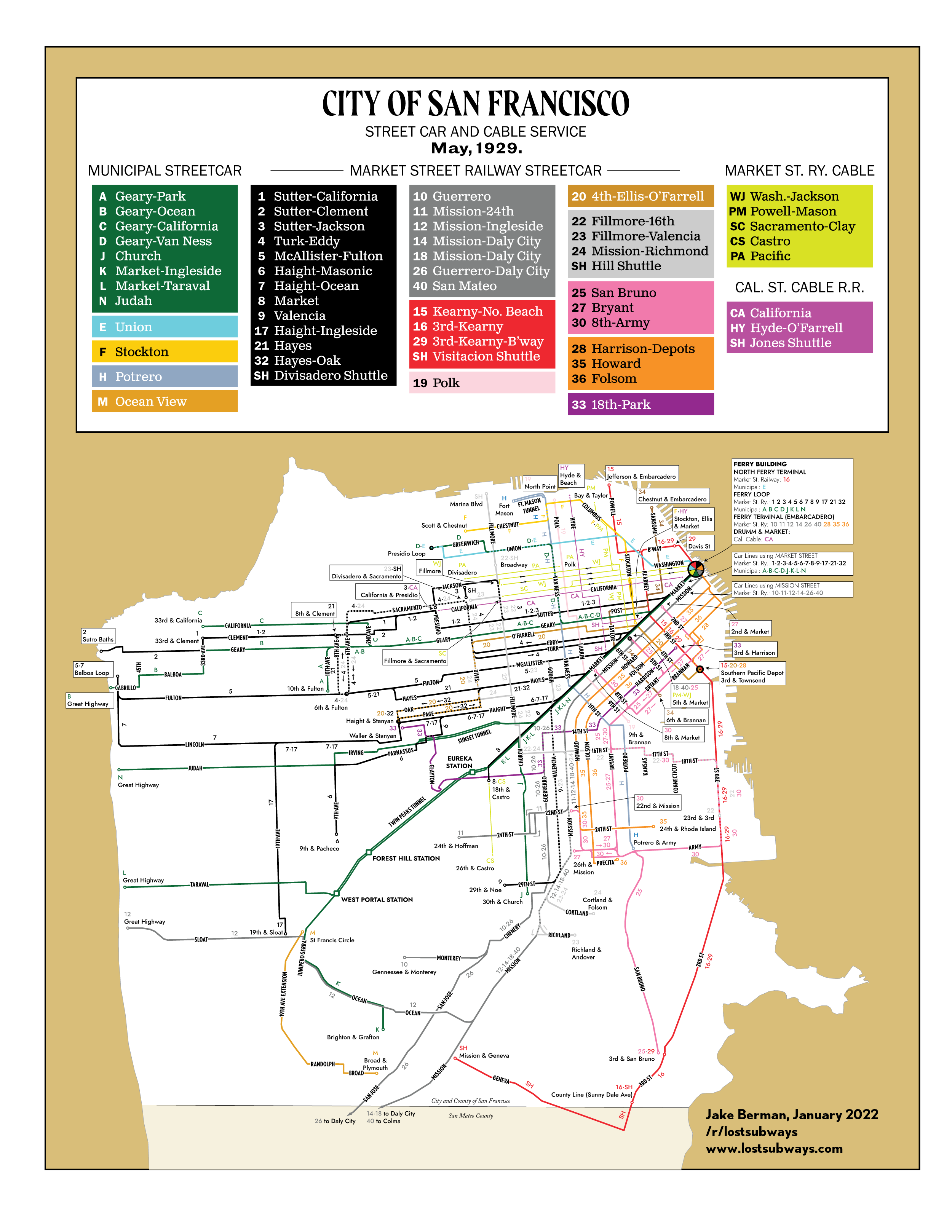
Newton made his case on some assumptions on what postwar San Francisco would look like. For one, Newton predicted that San Francisco’s wartime population and ridership would decline by nearly 10 percent and 27 percent, respectively.6 The rationale was threefold: the gradual end of the San Francisco-East Bay wartime economy; growing demand for suburban housing in the Peninsula down south; and the end of the strict rationing of automobiles, gasoline, and rubber tires that had heavily suppressed civilian car commuting.7 To fix its continued budget issues, Muni was granted its first fare increase from five cents to seven cents in 1944 — then another one in 1946 to raise it to 10 cents, doubling the fare as the local war economy faded out.
Newton’s plan did not, however, forecast a key factor: labor. Since absorbing Market Street Railways, Muni’s workforce added new members of several new labor unions. Like the streetcars and tracks, the workers themselves were exhausted and near breaking point.
Two separate unions — one represented by the American Federation of Labor and the other represented by the Congress of Industrial Organizations — demanded pay raises between 13 and 26 percent. When talks went nowhere, the unions went on strike on June 30, 1946. Mayor Roger Lapham negotiated until July 4, when Muni and the unions agreed on the condition of pegging Muni operators’ pay to the average of the two highest paying transit systems in California at any given time.8 In return, Lapham got to place a ballot measure to modernize Muni in November.
Muni deviated from the Newton plan for the upcoming November modernization ballot measure in three ways. First, a full repair of not only streetcar tracks but also the associated equipment, rights-of-way, and electrical distribution facilities had a higher upfront capital requirement — one Muni could not afford. Second, Muni was hoping to create express buses to connect previously underserved residential areas to downtown sans a need for rail. Third, and perhaps most importantly, the streetcars operated under an ordinance that required two employees at all times.9 The ordinance, created during the Great Depression, initially helped employ many workers on the cheap but soon became a major albatross on Muni’s finances, especially after the newly agreed labor contract of 1946 guaranteed huge pay raises for drivers. Buses did not operate under a two-man ordinance; it needed only one driver per car. To reach financial solvency, as the state government was demanding, Muni’s management eagerly began replacing streetcars for buses.10
Labor unions, dearly fighting for its two-man streetcar ordinance, also fought bitterly against the introduction of articulated buses, arguing the buses were so large they should be considered in the same category as streetcars. Muni’s management ultimately conceded and paused in deployment of articulated buses.
At the same time, unions joined a larger citywide movement, which included the local Communist Party branch, to stop a proposal from Mayor Lapham to raise fares from seven to ten cents.11 In 1946, Lapham — who would become more famous for his future fight, and loss, the next year to eliminate all cable cars in San Francisco — became the first mayor in San Francisco history to ever face a recall election.
In November, the Muni modernization bond measure easily cleared the two-thirds threshold, with seventy-seven percent approval. The $20 million bond was spent primarily on replacing obsolete streetcars with newer buses and trolleybuses. Within five years, nearly two-thirds of the existing streetcar fleet was scrapped and the number of buses rose nearly fivefold, from 183 to 891. The overdue replacements came with noticeable improvements in vehicular safety, cutting accidents by more than half, from 16,000 in fiscal year 1945 to around 7,000 in 1950.12
San Francisco averted an immediate short-term transit crisis by voting for a quick modernization plan. Now the city could look to the future. In early 1946, the San Francisco Planning Commission was preparing a master plan to guide the city’s growth. The master plan proposed two new grade-separated rapid transit rail lines in San Francisco: one under Market Street and the other on Geary Boulevard.13 The proposal became the foundation for a postwar push to dig under Market Street to construct a rapid transit system. That system found a champion in a 39-year-old freshman San Francisco supervisor named Marvin Lewis, who was deeply interested in the idea of creating an extensive Bay Area regional train network akin to one seen in New York City. Such was his interest that before the 1946 referendum, Lewis sought assurances that the Market Street streetcar track reconstruction would not impede plans for a future subway underneath.14
Two events helped the Market Street subway’s prospects. First, in November 1947, San Francisco replaced Roger Lapham with another Republican, Elmer Robinson. Robinson made transit a top priority, supporting a rapid transit system for the city and promising as mayor to submit another bond measure to finance its construction.15 Second, in November 1948, a roadmap for a subway system was published by the Planning Commission. The San Francisco Chronicle eagerly backed the subway plan, just as they had when San Francisco voters rejected a prior subway referendum in 1937. Smaller local papers were more skeptical, believing the subways would give Downtown elites more power than rest of the city. The local Communist newspaper supported the subway only if it would be financed by federal loans or property taxes.16
At the end of 1948, San Francisco transit was in a much better situation than three years prior. Voters had backed a modernization bond measure and elected a transit-friendly mayor in Elmer Robinson. Transit also had another champion in Supervisor Marvin Lewis. But while this side of the Bay was beginning to put the blocks together, the other side was still groping around in the dark.

Oakland and the Key System, 1945-1948
If San Francisco’s transit woes traced back to the 1930s and to World War II, the root of Oakland’s own issues could be traced as far as before World War I.
Oakland and its neighboring cities — Berkeley, Alameda, Emeryville, Piedmont, and San Leandro — were home to two competing interurban railway companies: the Key System and Southern Pacific. Unlike San Francisco, which had brought Muni under public ownership via voter referendum in 1912, in Oakland, the duopoly determined not just how people moved but also where people lived. The Key System, under founder Francis “Borax” Smith, serviced his 13,000 acre East Bay real estate empire.17 By 1913, however, the boom times had ended for both the Key System, now competing with new Southern Pacific electric streetcars, and for Smith, who was ousted from his company.
Both the Key System and Southern Pacific (later branded as East Bay Electric Lines) limped along after World War I and into the 1920s, due to the rise of private automobiles on East Bay streets, a fare frozen at five cents despite the soaring inflation of the early 1920s, and increasing labor costs. In 1923, the Key System declared bankruptcy. By 1927, unprofitable streetcar lines were being replaced with buses under the new leadership of local banker Alfred J. Lundberg. Lundberg fought tooth and nail against Oakland politicians and labor groups to establish one-man operation on Key System streetcars, something San Francisco had been unable to achieve.
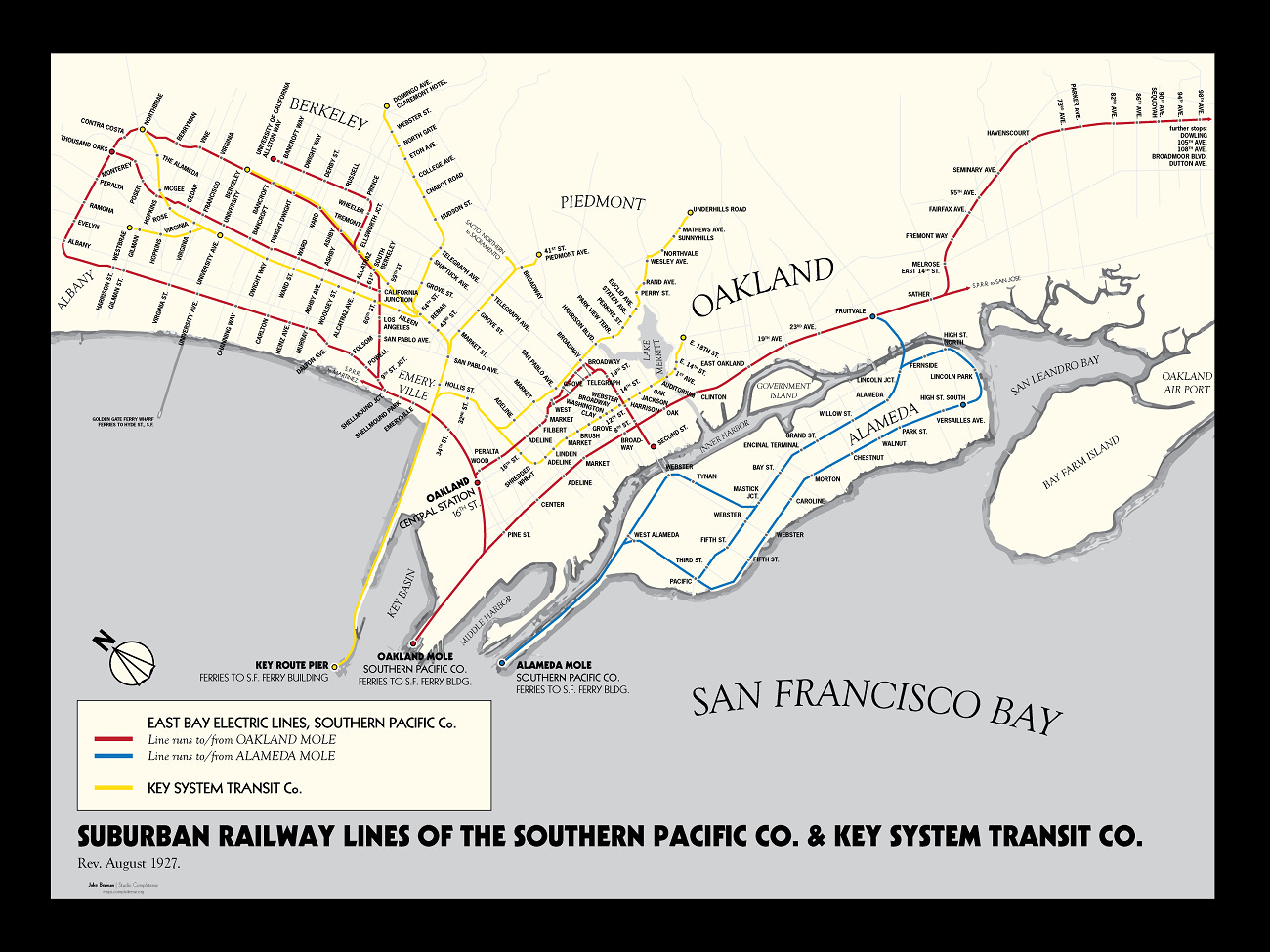
As the Key System reformed, Southern Pacific began withdrawing from the East Bay, closing streetcar routes starting in 1933. East Bay car ownership grew faster than in San Francisco, and transit ridership suffered. By 1939, the Key System carried 40 percent less ridership than in 1925. Bus passengers already made up half of its ridership.18
By August 1945, Oakland and the greater East Bay faced different challenges than San Francisco in several ways. For one, the Key System was the only operations in the area after Southern Pacific ceased operations in 1941. But they too were teetering on the edge of collapse.
During the war, the Key System had been kept afloat by its Bay Bridge Railways service, which provided the sole rail service across the San Francisco Bay on the lower deck of the new Bay Bridge, and by its Richmond Shipyard Railways, which shuffled factory workers based in Berkeley, Emeryville, and Oakland to the massive shipbuilding plants in Richmond up north. But these services were poorly maintained and often unreliable. The Shipyard Railway, for example, ran wooden streetcars built 40-plus years prior. It went out of service mere weeks after the war’s end because neither the Key System nor Kaiser Shipyards wanted to onboard maintenance responsibilities.19 Within a month of VJ-Day, Lundberg announced a modernization plan for the Key System which involved replacing all remaining streetcar service with buses, as soon as possible.20
Lundberg’s efforts came against the backdrop of an increasingly diverging postwar Oakland. The patrician elites and the rapidly growing industrial working class held very different visions for what a postwar East Bay should look like.
The elites, centered around the Knowland family, which ran the Oakland Tribune newspaper, saw the postwar recovery as Oakland’s chance to finally unseat San Francisco as the heart of the Bay Area. The Oakland Chamber of Commerce promoted their Metropolitan Oakland Area Program (MOAP), which envisioned a greater Oakland replete with desirable single-family suburban homes and downtown Oakland — not San Francisco — as the regional hub for commerce and culture.21 Unlike San Francisco, the East Bay had more undeveloped land to create this vision of an Edenic “industrial garden” to complete the “Detroit of the West.”22
The East Bay had emerged as the industrial heartland of Northern California after the war, with manufacturing plants spreading from Richmond to San Leandro. The Republican, anti-labor, and anti-communist Oakland elite — personified by the staunchly right-wing scion of the Knowland family, Bill, who was appointed to the U.S. Senate in 1945 — was in stark contrast to the New Deal-supporting union members of the Oakland working class. Heavily diverse across race, geography, and background, tens of thousands had recently moved to Oakland for plentiful wartime factory jobs. With the war over, this new coalition clashed with local elites spectacularly in a three-day general strike in December 1946. Other labor struggles, such as when African Americans fought the Key System to desegregate its workforce, marked Oakland as a site of rapid socioeconomic change in the postwar era.23
In May 1946, Lundberg sold his controlling interest in the Key System to National City Lines (NCL), shocking local politicos. Once a small Minnesota bus company, National City Lines grew rapidly after receiving equity from General Motors, Firestone Tires, and other automobile and petroleum companies to become a streetcar conglomerate. After the war’s end, NCL went on a buying spree of streetcar systems throughout California, including in Los Angeles, Fresno, San Jose, and Sacramento. Under new ownership, the Key System wasted no time requesting a fare increase and the replacement of the College Avenue streetcar line with buses from the California Public Utilities Commission, which regulates privately-operated transit.24
Local officials responded swiftly. A month after the NCL purchase, Berkeley Mayor Fitch Robertson called neighboring cities to convene a transit commission to weigh their options, recognizing that NCL, if left uninhibited, would tear up all Key System streetcar lines with no input from local cities.25 Their fears were well-founded, as NCL-owned streetcar networks underwent similar fates already.
But what exactly did the East Bay want out of the Key System, anyway? Like San Francisco with the Newton Plan, Oakland in 1947 hired a consultant, Harland Bartholomew, to draw a plan. Bartholomew’s plan harkened the Newton Plan in many ways, suggesting the Key System replace all but five streetcar lines in Oakland with buses, create an express bus network to connect outlying East Bay cities to Downtown Oakland, and shorten the Bay Bridge Railway to a shuttle service to improve reliability and speed.26
The Bartholomew Plan received mixed reactions. The Oakland City Council was cool to the Bay Bridge shuttle idea, and the powerful Oakland Chamber of Commerce was concerned that the Bartholomew Plan was too unambitious in its plans to better connect the East Bay suburbs to Downtown. Activists from the Oakland Voters League (OVL), a new progressive electoral coalition formed after the 1946 General Strike, called for a regional rapid transit plan — and for this regional rapid transit idea to be publicly owned. Another local progressive transit activist group, the Bay Area Transportation League, demanded the state toll bridge authority overseeing the Bay Bridge immediately seize the Key System from National City Lines and bring it into public ownership.27
By the end of 1948, Oakland’s vision for its postwar mass transit was taking shape. Local distrust in NCL and the Key System was growing. In 1947, the U.S. Attorney General indicted NCL for conspiring with petroleum and tire companies and General Motors to buy out streetcar companies, replace streetcar services with buses, and use them to secure sales in buses, rubber tires, and petroleum products. The companies would be convicted two years later and given a light fine. This case is the basis for the famous “General Motors streetcar conspiracy” (or the “Great American streetcar scandal”) commonly cited by transit advocates eighty years later.28 East Bay residents in 1947 were aware of NCL’s threat and wrote letters to local newspapers warning NCL’s intention to sell Key System for a quick buck in automotive products.29 Despite the outcry, public ownership of the Key System was still unthinkable — the local merchants and the Oakland Tribune were quick to call any intervention socialist apt for Moscow.
More critically, a consensus was building around the need for a regional rapid transit in the East Bay with two goals: connecting the rapidly growing East Bay suburbs around Oakland to Downtown Oakland and providing an alternative between San Francisco and Oakland that would improve on the Bay Bridge railway. A bolder successor to the Bartholomew Plan was needed. But this consensus, as we would later see, would be under constant threat from Oakland’s own parochialism and inferiority complex in relation to San Francisco. If a rapid transit was to come to be, then it needed to support Oakland’s ascendance and usurpation of San Francisco as the one true center of the Bay Area.
The genesis of Bay Area rapid transit
In 1936, the San Francisco-Oakland Bay Bridge opened for motorists; the reserved rail tracks on the lower deck opened for Key System service three years later due to delays. Streetcars from Oakland and Berkeley ran across the bridge to the San Francisco Transbay Terminal. Throughout World War II, as gasoline rations restricted long-distance commutes, the Bay Bridge railway was the main mode of transport over the San Francisco Bay. Rail ridership over the Bay Bridge nearly doubled during the war, from 14 million passengers in 1941 to 27 million in 1945.30
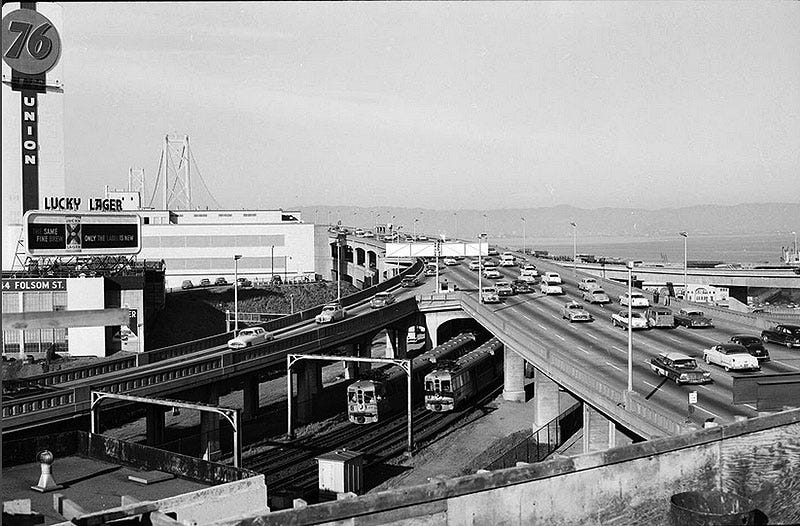
San Francisco’s civic leaders in City Hall and business leaders in the Financial District and on Market Street envisioned a radial rail network centered on the city’s downtown. They envisioned rapid transit down Market Street and Geary Street, heading southwest and west, respectively, to the rapidly growing suburbs in the Richmond and Sunset districts. To the east, they wanted to bring the transcontinental passenger rail network over the Bay Bridge and into San Francisco.
This Bay Bridge dream was anathema to Oakland elites, who wanted to tightly protect Oakland’s place as the western rail terminus.31 Oakland was also concerned about the rapidly returning car congestion on the Bay Bridge since the war’s end. Its leaders suggested a second Bay Bridge fully dedicated to motor vehicles.
To get ahead of Oakland, Richard Welch, the Republican House representative for San Francisco, drafted a Congressional bill to command the Army and Navy to produce a joint report on the feasibility of a second southern crossing over the bay in 1946.32 Welch called for rail service on the lower deck of the second crossing, like the Bay Bridge, which the mayor of Oakland to. As the Joint Army-Navy Board (JANB) began public hearings in the summer of 1946, the young San Francisco Supervisor Marvin Lewis became the face of San Francisco’s interests in the second crossing discussions.33
In January 1947, the JANB published its much-anticipated findings. To the surprise of local observers, JANB recommended that a second crossing south of downtowns San Francisco and Oakland be built, for automobiles only.34 JANB called for this in the name of predicted regional growth, taking a maximalist approach to its recommendations. Yes, the Bay Area — based on predicted growth — needed another car-only bridge, but it also needed a new rapid transit service, with grade-separated right-of-way that radiated into the suburbs from the two main downtowns. The grade separation meant that, perhaps, the Bay Bridge too could be fully converted to cars only. And how will this rapid transit system be connected across the Bay? JANB suggested an underwater tube, lying on the seabed of the San Francisco Bay. The report also acknowledged this rapid transit service would be critical to resolving congestion concerns, calculating that a single rail track could carry 20 times more people than one car lane on the Bay Bridge.35
Both civic and business leaders in San Francisco and Oakland welcomed the JANB recommendations. But the where and the how for the bridge would be far tougher questions to answer. Between 1947 and 1949, San Francisco and Oakland haggled over a southern crossing option reaching from south of Market Street on the west bay to Alameda Island on the east — or a parallel bridge 300 feet north of the Bay Bridge. Oakland strongly wanted the parallel bridge to direct more traffic to its city center; San Francisco was more divided, with downtown business leaders wanting the parallel bridge and City Hall, including Supervisor Lewis and Mayor Elmer Robinson, preferring the southern crossing. Robinson “pulled out all the stops”, as the Oakland Tribune sardonically commented, to have the federal government, instead of local governments, decide the location of the second crossing.36 Making his case in front of Congress, Robinson invoked a scenario of a chaotic logjam of fleeing civilians cramming at the adjacent entrances of the Bay Bridge and the parallel bridge should Communist forces invade the Bay Area from the south of San Francisco.37 Ultimately, Robinson’s argument won out, as the Defense Department voiced its opposition to the parallel bridge option. However, the decision from Washington did not settle the question on the second crossing’s location, as local talks continued.
As the discussion over a second crossing edged toward a stalemate, Lewis quietly pursued the other recommendation in the JANB report: a rapid transit service with an underwater tube. As a reminder, in 1946, Lewis had supported the San Francisco Planning Commission’s Master Plan envisioning a subway underneath Market Street. In December 1947, he proposed the creation of a Bay Area Transit Authority covering five counties — San Francisco, Alameda, Contra Costa, San Mateo, and Marin — to plan this JANB-recommended rapid transit system.38 Five months later, the Bay Area Transit Committee, with each county represented, met for the first time. Lewis was elected chairman, and he immediately ran into roadblocks with one party in particular: Oakland.
Oakland politicians had made their rapid transit goals clear: it must be centered around Downtown Oakland and any part of this system not touching Oakland was irrelevant as far as they were concerned. The majority of the Oakland City Council was convinced that this Bay Area Transit Committee was a San Francisco plot to extend Muni’s ongoing financial issues to the East Bay — or even the first step in annexing Oakland into San Francisco. The latter, touching a raw and longstanding Oakland nerve, was inflamed by Mayor Robinson’s comments about creating a “Greater San Francisco” in the mold of New York City.39
The committee further inflamed Oaklanders by suggesting this new rapid transit system be publicly owned. The hardline conservative Oakland City Council majority — devotees of Senator Knowland, who had by then risen to be the figurehead of the right-wing of the Republican Party and a potential presidential candidate — was strongly opposed to any public ownership of transit agencies. Despite the sympathetic progressive Oakland Voters League Council minority, the City Council stymied Lewis consistently, going so far as to vote down a resolution approving the mere concept of a Bay Area Transit Authority. Lewis even had to go on record to assure Oakland leaders he was not “trying to foist upon [Oakland] San Francisco’s local transit difficulties.”40
The fight made its way to Sacramento. In 1949, state Senator Gerald O’Gara, who represented San Francisco, authored a bill to create regional transit districts in the Bay Area and Los Angeles. 41The initial draft included an appointed board of directors across multiple cities and counties, the right to acquire lands by eminent domain, and the ability to finance their system through general obligation bonds and property taxes. These districts would be responsible for all transit services in their jurisdictions and prepare comprehensive transit plans to expand and improve their services. However, the Oakland Tribune called out O’Gara’s bill as a Trojan horse intended to “give San Francisco a whiphand” over neighboring cities and counties.42 The bill was objected and whittled down by Alameda County senator Arthur Breed before being passed into law that Lewis decried as useless.
By the end of 1949, the explosion of postwar idealism was petering out. The state of mass transit in San Francisco, Oakland, and the Bay in between was in troubled waters: San Francisco was left without a rapid transit plan to push forward, Oakland’s Key System was on the ropes, the second bridge crossing the San Francisco Bay was stuck in a quagmire, and the concept of a Bay Area rapid transit system was going nowhere. In the next decade, the standing dominos would have to fall.
San Francisco, Oakland, and the Bay: 1950-1953
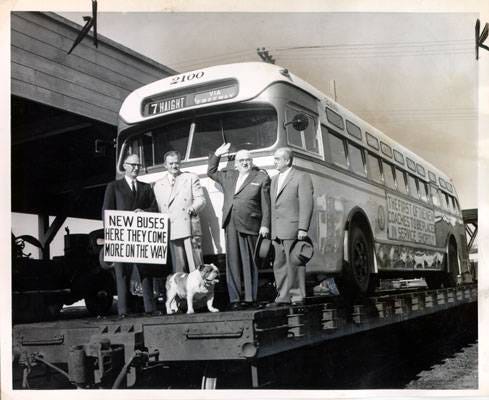
In the postwar half of the 1940s, San Francisco’s Muni underwent a transformation that in other cities may have taken decades. After absorbing the Market Street Railway in 1944, it embarked on a modernization campaign to replace much of its streetcar network with trolley buses. Fifteen formerly Market Street Railway streetcar routes became bus routes in 1948 and 1949, while five longstanding Muni streetcar lines (B Geary, C California, D Van Ness, E Union, F Stockton, and H Potrero) were also replaced with buses between 1950 and 1956.43
But Muni’s modernization efforts did not slow its postwar ridership decline; annual ridership went from 244 million in 1945 to 188 million in 1950 — a 23 percent drop. Throughout the 1950s, Muni would see steady ridership declines year-over-year until the early 1960s, when it stabilized around 144 million passengers annually. Within a generation’s time, Muni carried 100 million less rides a year. 44 As ridership declined, Muni balanced its budget on subsidies from city government through the 1950s.
In December 1949, Supervisor Lewis and Mayor Robinson, two of San Francisco’s most ardent transit allies, formed a citizens’ advisory committee to examine the future for a Bay Area rapid transit system rendered confused by the watered down O’Gara bill in Sacramento.45 They recruited influential San Francisco financiers, such as municipal bonds banker Alan Browne, investment banker Arthur Dolan, and department store merchant Cyril Magnin, to the committee. These three men, plus Lewis, would become instrumental founding fathers of BART. Robinson still wanted his Market Street subway system and pushed for a ballot measure in the upcoming 1950 midterm elections. But the start of the Korean War in June 1950 forced Robinson to shelve the idea.46 With America back at war, Robinson spent the next three years focused on the second crossing project instead.
Oakland’s transit woes made San Francisco’s Muni troubles look rather quaint. Between 1946 and 1950, the Key System’s streetcars and buses saw annual ridership drop from 31.5 million to 18.3 million — a staggering 42 percent decline.47 Transbay service on the Bay Bridge fell even more precipitously, from 22 million in 1946 to 9.8 million in 1952.48 Unlike Muni, the Key System was privately owned and was expected to keep itself afloat. By 1949, their remedies were higher fares and less service, and they applied to the CPUC for permission to do so again setting off what could be described as a death spiral: less riders meant less service which led to less riders and so on.49
Local leaders recognized this threat and convened a commission to ask whether the Key System should be a public good. A report from the Oakland Planning Department suggested public ownership of the Key System. But expectedly, Oakland’s civic and business leaders could not abide by what was tantamount to Soviet-style socialism. At the height of the McCarthy anti-communist years, they were so fixated on this belief that even calls to build parking lots in Downtown Oakland were labeled by them as socialism — they were considered “housing for the underprivileged automobile.”50
Between the Korean War years of 1950 and 1953, the second crossing negotiations took up most of the oxygen in the Bay Area transportation debate. Mayor Robinson and the San Francisco interests frequently clashed with Oakland’s, led by Mayor Clifford Rieshell and the Knowland family. (In one attempt at rapprochement, Lewis would call the Oakland Tribune and consult with the Knowland family.51) At one point, Robinson proposed two new bridges — one north of the Bay Bridge and one south — so each city could choose one of the crossing’s locations without protest from the other.52
![Joseph R. Knowland;William F. Knowland [& Family]](https://substackcdn.com/image/fetch/$s_!yUyK!,f_auto,q_auto:good,fl_progressive:steep/https%3A%2F%2Fsubstack-post-media.s3.amazonaws.com%2Fpublic%2Fimages%2Fd36e9978-c61e-4448-bae0-ef7f26cefb74_2048x1406.jpeg "Joseph R. Knowland;William F. Knowland [& Family]")
In 1953, the California state legislature passed a bill to green-light the southern crossing project — not Oakland’s favored parallel bridge idea — between Potrero Point in San Francisco and Bay Farm Island, south of Alameda. Then suddenly, the Navy vetoed the project, revealing they had their own seaplane development plans for Potrero Point.53 And so, talks would continue until 1958, until the second crossing project fizzled out to second in rank behind the rapid transit project, which was chugging along.
Throughout 1950, Lewis worked quietly with his citizen’s advisory committee to rebuild his dream of Bay Area rapid transit. The year after, Lewis helped draft four bills for discussion in the California state legislature. Three of the bills were focused on overturning the O’Gara bill; all were shot down. The fourth bill, with the blessings of Senator Arthur Breed, was for the creation of a state-level regional transit commission. This bill, Senate Bill 549, created the Bay Area Rapid Transit Commission (BARTC) with 26 members from the nine Bay Area counties — the San Francisco delegation included Lewis, Dolan, Magnin, and Browne — and a $50,000 budget (Lewis had asked for a budget six times larger).54 BARTC used the money to hire consultants DeLeuw, Cather, and Company to build a preliminary report on behalf of the commission.
When the preliminary report was published in December 1952, it outlined a program of regional planning and engineering studies further needed to build the case for a Bay Area rapid transit system. The next year, the California state legislature passed a bill for BARTC to grant them this planning work and $400,000 of a requested $750,000 budget. BARTC agreed to seek the remaining $350,000 from Bay Area counties.55 The BARTC research program would need to be led by consultants adept at regional planning. The commission chose the New York City-based Parsons, Brinkerhoff, Hall, and MacDonald (PBHM) for the task.
Despite choosing to bring in a heavy hitter known for planning large transportation projects in the East Coast in PBHM, BARTC often clashed with its own consultants. When PBHM submitted their first report to the BARTC Engineering Committee, the commissioners were dismayed to find PBHM’s first draft was basically the Key System on the Bay Bridge with extensions into San Francisco. The planned trains would run at an average of 45 miles per hour, with top speeds of a mere 80 mph. San Francisco’s Magnin complained this was nowhere near ambitious enough for the Bay Area, quipping that if the United States “can develop the atom bomb and the hydrogen bomb, then they can develop a transit system that is in keeping with our times.”56
Interestingly, the Oakland delegation agreed with Magnin’s ambitions and began pushing for the rapid transit system. After losing their parallel bridge concept to the southern crossing in Sacramento, Oakland leaders pivoted rallying around an Oakland-centric rapid transit system. This system, with an underwater tube, also would free up the Bay Bridge’s lower deck for automobiles.57 It was now in their interest that the rapid transit system be planned as successfully as possible, with faster trains and new technologies.
Oakland’s softening stance did not mean harmony within BARTC; in fact, it was more caustic than ever before. In 1952, the Key System applied to state regulators to abandon rail service altogether (it was denied). The summer after, Key System workers went on a strike for two and a half months, paralyzing much of its service in Oakland and Berkeley and further crippling Key System’s local reputation.58 The Key System was falling apart, and at last, Oakland’s leaders accepted the reality as such. They began discussing the creation of an Alameda County transit district to take over the Key System. The simultaneous creation of a Bay Area rapid transit district and a publicly owned transit district in the East Bay at the same time would wed the two projects together for the remainder of the 1950s.
Hello, BART and AC Transit; goodbye, Geary streetcar: 1953-1957
As Marvin Lewis became the de facto face of San Francisco’s transit movement, two men emerged as Oakland’s own: the downtown merchant Sherwood Swan and Piedmont-based lawyer Clair MacLeod. Both Swan and MacLeod served on BARTC as part of the Alameda County delegation. MacLeod formed the East Bay Transit Committee to examine the logistics of a public takeover of the Key System. Swan experienced firsthand the crippling 1953 Key System strike and was convinced the Key System needed to be municipalized.59 Swan and MacLeod played key roles in drafting a bill to create an Alameda-Contra Costa transit district for local state Senator Arthur Breed. Both saw it as a local matter that needed to be handled urgently — much to the shock and bitterness of their San Francisco peers on BARTC.60
Swan, MacLeod, and Breed largely kept the San Franciscans in the dark about the bill, believing this was a strictly local issue that had no bearing on BARTC. As they saw it, they were creating their own Muni in the East Bay. But Lewis and his allies saw it very differently: they worried another newly created public transit agency in the Bay Area would siphon voter support away from the rapid transit system and jeopardize local bond financing. Lewis saw this as a betrayal of his idealistic notion that the Bay Area counties should work as one unit to build a transit network together.61
San Francisco state Senator Gerald O’Gara shared the betrayal, harkening to his experience of getting his transit authority bill in 1949 picked apart by Breed.62 Now, Breed, who had long resisted public transit in the East Bay, had in hand a bill to create a transit district for his backyard. But the Oakland elites had had a change of heart and they could not be stopped. Even the Knowland patriarch, Joseph, came around to a public-owned Key System, saying that, while he was still ideologically opposed to it, “we are here confronted with a condition, not a theory.”63
On January 6, 1955, representatives from San Francisco, Alameda, and Contra Costa counties convened to smooth over the disagreements, agreeing the new Alameda-Contra Costa County transit district would not interfere with another transit organization’s facilities or operations and it would work with partner agencies on operations, fares, and other arrangements.64
With San Francisco satisfied and BARTC now publicly endorsing the bill, Breed introduced Senate Bill 987 on the senate floor twelve days later. Despite Breed’s usual conservatism, SB 987 was a radical piece of legislation on two fronts: first, the new district was authorized to levy a property tax for any district purpose with no limit on rates; and second, the new district would recognize and grant collective bargaining to represent labor unions, a first in California transit history. (In return, the unions would forfeit their right to strike.)65 SB 987 was signed into law by Governor Goodwin Knight in July 1955, and the Alameda-Contra Costa Transit District, AC Transit, was approved by voters in the two counties in November 1956.
However, it would take four more years for AC Transit to fully replace the Key System. By 1956, the Key System was a shell of its former self. Despite increasing transbay fares 250 percent between 1946 and 1954 and reducing the Bay Bridge rail lines from eight to five, the Key System in 1955 filed to the CPUC, again, for permission to abandon all rail service on the Bay Bridge.66
The CPUC made its decision in March 1957 after consulting BARTC staff, aware that a potential new transbay rail system was in the works.67 On April 20, 1958, the Key System ran its last trains on the Bay Bridge, replacing them with buses. With the Key System in terminal condition, AC Transit in 1958 asked voters for a $16.9 million bond to officially replace the Key System as the region’s transit service.68 The money was to be split between acquiring all of Key System’s land, facilities, and 276 used buses and the purchase of 304 new buses. The ballot measure passed with 57 percent approval.69 AC Transit-branded buses would run on East Bay streets for the first time in 1960.
As the East Bay bid farewell to the Key System streetcars, San Francisco in 1956 said goodbye to its oldest streetcar line: the B Geary line. Despite overturning the costly two-man streetcar requirement with voter approval in 1954, the B Geary by 1954 remained on the chopping block due to two new developments.70 First was the urban renewal plan for the Black-majority Western Addition neighborhood, which involved widening Geary to build an underground expressway for faster car travel. This construction work meant tearing streetcar tracks at the route’s geographic center. Second was the rapid transit plan, which most San Franciscans entrusted would include a line from Downtown San Francisco up to Marin County in the north via Geary and the Golden Gate Bridge. Since Lewis and Robinson’s plans for a Muni subway, Geary and Market had always been the twin trunks for the system.71
Few San Franciscans, including the new mayor George Christopher, who approved the closure of the B Geary in 1956, could have foreseen that, just a few years later, the Geary-Marin leg of the Bay Area Rapid Transit system would be nixed, and generations of San Franciscans would pursue a Geary subway since.
The closures of Bay Bridge Railways and the B Geary line occurred based on expectations of the incoming rapid transit system. What did that entail, exactly? In January 1955, Parsons, Brinkerhoff, Hall, and MacDonald published their final report on the regional rapid transit plan to BARTC. The report contained the first concrete plan for the future BART system: five radial lines jutting out into the suburbs of the East Bay, Marin County, and the Peninsula from a central trunk line running between downtown San Francisco and downtown Oakland.
PBHM proposed two ways this system could be built: the Minimum Plan and the Optimum Plan.72 The Minimum Plan called for the Bay Bridge rail link. The Optimum Plan was the gilded alternative: a transbay tube under the Bay with underground stations through both downtowns. The Minimum Plan was projected to cost $586 million ($7.3 billion in 2026 dollars); the Optimum Plan would cost more than a fifth extra, $713 million ($8.9 billion in 2026).73


As ambitious as it was, the PBHM report also revealed the imaginative constraints of the project planners. The project leader at PBHM, Walter Douglas, spelled out in a previous report to BARTC in 1955, a year prior to the final report, that this system was mainly intended for suburban commuters. They would be taking transit for two reasons: commuting and shopping downtown. With this target demographic, Douglas believed the “success of interurban rapid transit will depend upon its competitive posture in relation to the private automobile,” and that this would require reducing transfer opportunities and the number of stations on each line to maximize speed.74
Douglas and his team were also content staying in their lanes about how housing would intersect with this new transit system. Single-story suburban housing was mushrooming throughout the Bay Area in the postwar boom, and PBHM believed it was the rapid transit system’s mandate to supplement the suburban residents’ travel needs rather than challenge or alter their environment form or behaviors.
In addition, BARTC staff believed this courting of suburban voters was not only good politics for future ballot measures, but also politically progressive. Staff noted the suburbs were growing with working-class families, many of whom labored in factories and historically supported public transit ballot measures. One telling example is a promotional story BARTC shared with San Francisco schoolchildren of a fictional girl named Mary whose father worked day and night at a factory in San Mateo. “Mary wished there was some way he could get to and from work faster. … Then he wouldn’t be so tired and could spend more time playing with her,” the story ends.75
Cities and counties throughout the Bay Area picked apart the PBHM plan for months after its publication. In April 1956, San Francisco published its own report, calling for a Muni rapid transit system to be built in tandem with the regional rapid transit system along Market Street.76 It also requested that PBHM plan for two stations in the Mission district, rather than one, to encourage more local use. San Francisco and Oakland’s business groups by large backed the Optimum Plan. Dissent came from local taxpayer associations and select engineers, including Arthur C. Jenkins, who served as consultant engineer to the Golden Gate Bridge District. Jenkins, who would be instrumental in killing off BART’s plan to build tracks on the Golden Gate Bridge, argued the Minimum Plan was sufficient. Jenkins was not convinced the regional demand was there for the Optimum Plan.77
In May 1956, BARTC voted to adopt the Optimum Plan as their choice. The BARTC’s endorsement for the Optimum Plan had a domino effect on its twin project, the southern crossing. After the Bay Bridge Railways closed, the lower deck was opened for automobiles, and appetite for a second crossing decreased. In March 1956, BARTC chairman Alan Browne shared with the San Francisco Chronicle that he hoped the southern crossing project would be postponed as the regional transit plan moved forward. Browne also suggested that bridge tolls reserved for the construction of the southern crossing be instead be used to finance the construction of the regional transit system and its prized underwater tube.78
After endorsing the Optimum Plan, BARTC only had one job left: creating a Bay Area Rapid Transit District to finance and transform its plans into reality. In January 1957, the bill to create a BART District, Senate Bill 850, was introduced to the senate. The bill included six counties in district territory (San Francisco, Alameda, Contra Costa, Marin, San Mateo, and Santa Clara), but after a bitter fight with Peninsula elected officials, BARTC removed San Mateo and Santa Clara counties from the district.79 This alarmed San Francisco politicians, who believed San Mateo was integral for a peninsula line. San Mateo was wooed back only after BARTC surrendered its power to levy a sales tax in the district to fund construction.80 BARTC also agreed to set the electoral threshold to approve a bond measure at two-thirds, instead of simple majority; to have all district counties sign off on a future bond measure before putting on the ballot; and to cap their property tax levying powers to five cents per $100 assessed valuation, from the original ten cents.81 Nearing the finish line, BARTC was willing to make heavy concessions to not only realize the BART District but codify the Optimum Plan as the state-mandated construction plan.
In June 1957, the bill finally passed the state legislature and governor’s desk to become California law.82 The last thing BARTC had left to do after SB 850 passed was to dissolve itself so that the new Bay Area Rapid Transit District could take its place.
Resurrection, or reinvestment?
This story ends where stories of BART and Bay Area public transit usually begin. With the creation of the BART District in 1957, the seismic work of convincing an electorate to fund the construction of BART in 1962 and the actual, years-long labor of construction of the system followed. BART did not open for passenger service until 1972 and did not run its first train through the Transbay Tube until 1974. San Francisco’s Muni Metro, which constructed its own stations on the mezzanine level above the BART platforms under Market Street, did not open until 1980. If the 1947 Joint Army-Navy report serves as the postwar genesis of a Bay Area rapid transit network, then it took more than three decades for the vision outlined in the report to be fully realized.
The end of World War II heralded a new era for the Bay Area, one with many – and often conflicting – visions for what the region could become. It seemed the Bay Area bought into the promise of resurrection, as the New York Times dispatch observed during the United Nations Charter convention in San Francisco in 1945. Did its struggling transit network too experience a resurrection? I believe so.
The current Bay Area transit landscape is faster, more reliable, and more expansive than the streetcar days of yore. Despite the heavy nostalgia associated with pre-war streetcar networks, the Bay Area sports arguably the most diverse network of transit modes in the United States outside of New York City. Bay Areans also take their transit at a higher rate per capita than every other metropolitan region in the United States outside New York City, per Federal Transit Administration data from 2024.83 Despite the many misgivings and frustration that the region has about its public transit, the Bay Area has not taken its resurrected transit network for granted.
The inconvenient truth about public transit is that it needs continuous reinvestment. The titanic and slogging political work it took to create the BART, AC Transit, and Muni we are so familiar with today shows that we cannot get complacent that these systems will always be there for us for generations to come.
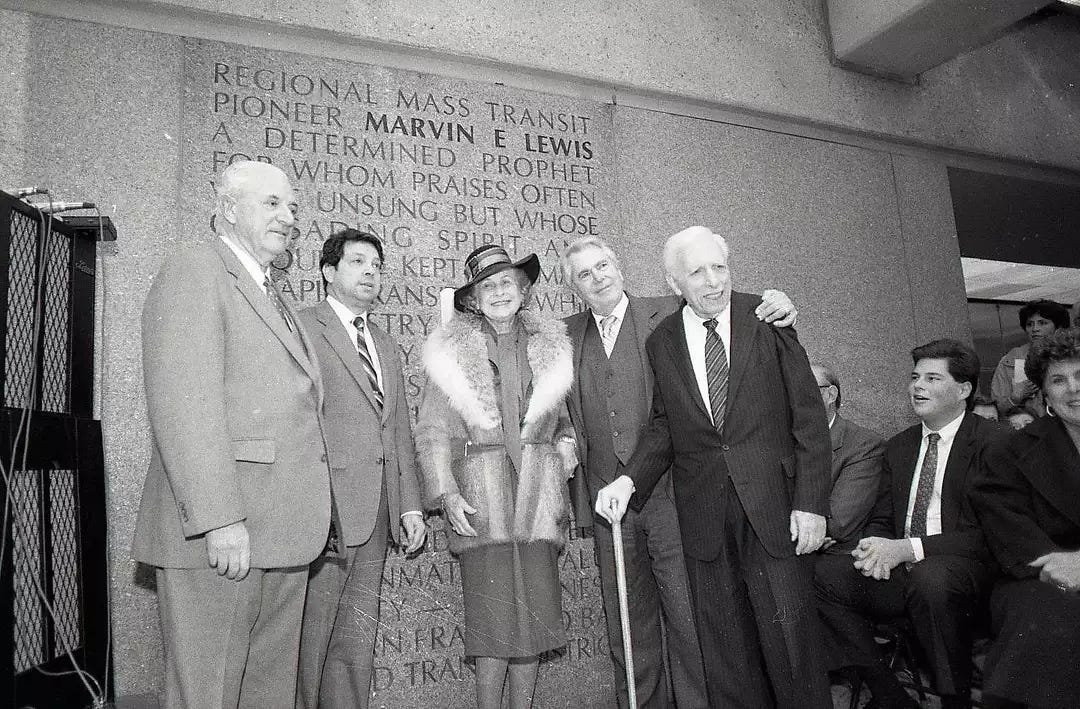
Both San Francisco and Oakland are littered with haunting reminders of dead transit not given second life: the abandoned 16th St station in west Oakland, the Key Route Plaza building on 41st and Piedmont in north Oakland, and the underdeveloped park where the San Francisco Transbay Terminal once stood. And the men who led the charge of resurrecting Bay Area transit are now also mere ghosts hardly remembered: Sherwood Swan’s name graces a downtown Oakland market; an alley near Powell Station bears Cyril Magnin’s name; and Marvin Lewis, the “dedicated prophet” of Bay Area rapid transit is remembered by a lonely marble plaque at Embarcadero Station. Only the rails and trains they fought for years remain – for now.
This November, Bay Area public transit as we know it is on the ballot. It stands at a major crossroads where its survival is at stake. I wrote this post as I felt the region should be reminded how arduous it was to create the network we know today and how uncertain its course was from conception to birth. Resurrection is never guaranteed. Let’s do the boring work of reinvestment instead. Let us move forward with clarity and courage.
https://www.sfchronicle.com/opinion/article/San-Francisco-the-birthplace-of-the-United-6336655.php
Ibid.
Seymour Adler. (1980). Redundancy in Public Transit - Vol III. The Political Economy of Transit in the San Francisco Bay Area, 1945-63, p. 9
Adler, p. 12
https://www.in2013dollars.com/us/inflation/1945?amount=23000000
https://babel.hathitrust.org/cgi/pt?id=uc1.c100897734&seq=41
Ibid.
https://www.streetcar.org/rails-to-rubber-muni-1946-1962/
Adler, p. 13-14
https://www.streetcar.org/what-might-have-been/
Adler, p. 17
Adler, p. 19
Adler, p. 20
Adler, p. 21
Adler, p. 24
Adler, p. 28-29
https://www.historyofpiedmont.com/keysystem
Adler, p. 59
https://www.wrm.org/visit/car-roster/passenger-cars/interurban/item/66-key-system-561
Adler, p. 59
Self, R. O. (2005). American Babylon. Princeton University Press, p. 25
Self, p. 26-27
Self, p. 55-56
Adler, p. 62
Adler, p. 67
Adler, p. 63-65
Adler, p. 70-71
https://nissenbaum.tech.cornell.edu/papers/Kwinty.pdf
Adler, p. 69
Adler, p. 33
Adler, p. 38
Adler, p. 39
Adler, p. 39-40
Adler, p. 40-42
Ibid.
Adler, p. 50
Adler, p. 51-52
Adler, p. 72
Adler, p. 77
Adler, p. 76
Adler, p. 79-81
Adler, p. 79
https://en.wikipedia.org/wiki/List_of_defunct_San_Francisco_Municipal_Railway_lines#Defunct_streetcar_routes
Adler, p. 94
Adler, p. 85-86
Adler, p. 190
Adler, p. 96
Healy, M. C. (2016). BART: the dramatic history of the Bay Area Rapid Transit system. Heyday, p. 31
Adler, p. 96
Adler, p. 90
Adler, p. 116
Adler, p. 111
Adler, p. 117
Adler, p. 122
https://www.foundsf.org/San_Francisco_Bay_Area_Rapid_Transit_Commission%E2%80%94The_Beginningsm
Adler, p. 137
Adler, p. 144
Adler, p. 146
Adler, p. 147
Adler, p. 147-148
Adler, p. 150
Adler, p. 149
Adler, p. 155-156
Adler, p. 150
Adler, p. 152
https://trolleytuesdays.blogspot.com/2021/05/trolley-thursday-5621-key-system.html
Adler, p. 233
https://www.actransit.org/sites/default/files/2020-08/public-transit-plan-summary-1958.pdf
https://www.actransit.org/sites/default/files/2020-08/ar_1959-1960.pdf
https://www.streetcar.org/what-might-have-been/
https://www.streetcar.org/what_might_have_been_geary/
Adler, p. 181
Adler, p. 182
https://www.in2013dollars.com/us/inflation/1955?amount=713000000
https://www.in2013dollars.com/us/inflation/1955?amount=586000000
Adler, p. 160-162
Adler, p. 135-136
Adler, p. 190
Adler, p. 198
Adler, p. 230
Adler, p. 237
Adler, p. 240
Ibid.
Adler, p. 241
https://www.transit.dot.gov/sites/fta.dot.gov/files/2025-11/2024%20National%20Transit%20Summaries%20and%20Trends%201.1.pdf